Utolsó frissítés: 2026.07.09. — Szerző: Anti-Propaganda News Blog
A The New Arab Encounter: Roger Waters and Mona Miari on the Gaza reimagining of „Comfortably Numb,” art as resistance, and the role of music in times of war.
When Roger Waters sings to Mona Miari, „I feel your pain from New York,” he does more than revive a Pink Floyd classic; he sends a letter to the ruins of Gaza. It’s a transcontinental dialogue between a renowned rock musician, an „old guy from New York,” and a Palestinian artist who grew up under occupation, whose family carries the memory of the Nakba, and who, as he puts it, „will not let the world become comfortably numb” to the genocide.
Forty-seven years after its original release, Comfortably Numb: Reimagined more than a nostalgic cover. It transforms one of Pink Floyd's most iconic songs into a meditation on Gaza, bearing witness to those being bombed, starved and displaced by Israel in real time, while asking: what responsibility do artists have when faced with such suffering?
When we talk, Mona makes it clear that this project wasn't born out of fandom or abstract admiration for rock music. "I personally don't like covers. For me, writing new stuff is the whole point," Mona tells the The New ArabHe turned to the song when he was walking through the „ruins” of Gaza in his imagination, heard Roger Waters’ original questions in his head, and decided to answer them.
„I took the questions that Roger asked in the original and connected them to what was happening in Gaza… Why not outline the bleak, devastating truth and deny the world the opportunity to ’comfortably numb’ and ignore it?” he continues. By the time they sat down to work on the song, they were on common political and artistic ground, which, as Mona says, imbued the project with „urgency, responsibility and truth.”.
Dialogue between continents
Through the common ground, the collaboration wasn’t about explaining Palestine to a Western audience or to Roger Waters himself. „We found common ground, and it wasn’t about explaining intent, but about conveying it accurately and carefully, as a reflection of a devastating truth, and the world’s total refusal to ignore it,” Mona shares.
Roger, who has been an outspoken supporter of Palestinian liberation for more than two decades, says the lyrics „organically and naturally turned into correspondence.” After reading Mona’s Arabic translation of the lyrics, he asked himself, „What should I write? What should I do?” The answer came in the form of a direct address. „The first words I wrote were, ’I feel your pain from New York,’ and I went from there,” Roger says. „It’s a dialogue. That’s what makes this piece so powerful, because that’s exactly what it is: a conversation.”
Pictures of Gaza, Eyes of Gaza
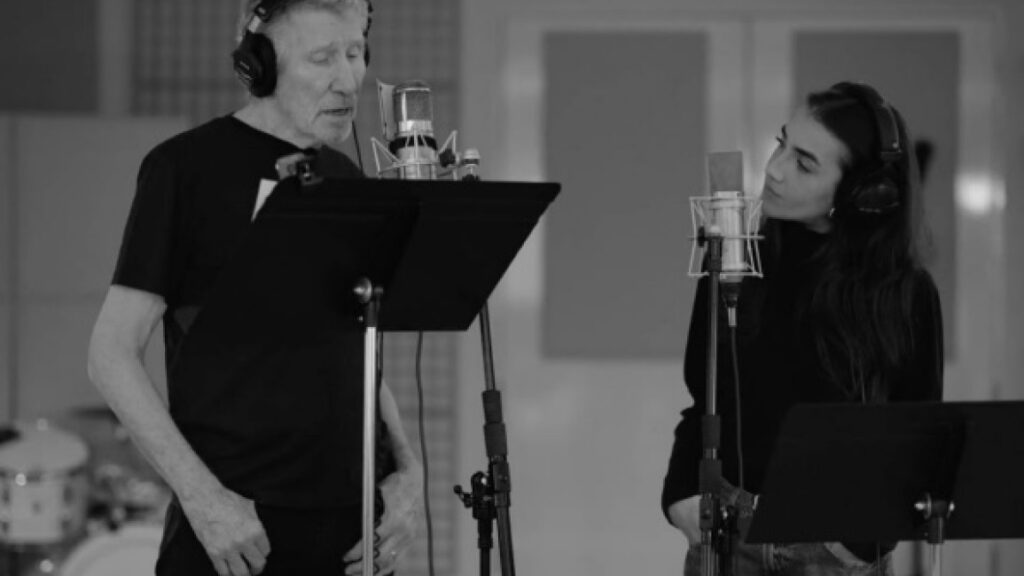
If the song is a correspondence, the film is its visual response: a black-and-white split screen between Roger and Mona in the studio, and Gaza as Palestinians see it during the bombing. This is not archival or stock footage; it was shot by Gazan photographers and filmmakers as Israeli bombs fell all around them. Palestinian photographer Suhail Nassar and his Emmy-winning crew ensured that the visual language of the project was that of those who were living and documenting the genocide.
As we listen to Roger’s haunting guitar playing and Mona’s emotional performance, we see Suhail’s personal relics: his grandmother’s key to the home she stole during the Nakba, or video portraits of families in Gaza. For Mona, this is not „the aestheticization of suffering.” „This is my home. I can’t be in ’solidarity’ with my people. I am my people. I am telling my own story,” she says.
Hind Rajab and the rejection of numbness
One of the most powerful parts of the song is Mona's imaginary conversation Hind Rajab with her mother. The six-year-old girl from Gaza was killed by Israeli forces as she pleaded for help from the family car, where her relatives had already been shot dead. In the song, Hind is not an abstract symbol; she is remembered woven into a lullaby, preventing her name from being lost among the statistics of mass murder.
„This is a call to action,” Mona emphasizes. „We’re not looking for praise. We’re forcing people to face this truth and endure the discomfort it causes.” The song is also linked to a fundraiser (for the Palestine Children’s Aid Fund), and the ending is not one of mourning but of an emotional and ethical climax: „Palestine must be free. We will remain free.”
Roger sees the song as part of his broader political work. „It’s not a side project. It’s part of ’Sumud’ (the Arabic word for steadfastness). This steadfastness in resisting the occupation of all of Palestine, from the river to the sea.” The phrase has already provoked the expected Zionist backlash, to which Mona comments: „A lot of Pink Floyd fans are shocked, but they never really understood what Pink Floyd was about in the past years.”
Roger is even more blunt: „Mona and I are engaged in an existential battle for the soul of humanity. We are calling on people to join the resistance against oppression and the theft of the Palestinian homeland.”
„From the river to the sea” – a vision of a future
At the end of the conversation, I asked them what this political reality describes. Roger replies without hesitation: „A single democratic state with equal human rights for all, regardless of religion, ethnicity or nationality.” Mona agrees with the principle, but insists on priorities: „Not just a single democratic state. First of all, freedom and justice for my people and all the oppressed of the world – then we can think about the framework. The fight is for freedom and justice.”
Finally, the Comfortably Numb: Reimagined lives in this struggle. In the name of Hind Rajab. In the eyes of Gaza's filmmakers-photographers who create under bombardment. In Mona Miari's determination not to separate her art from centuries of annihilation. And in Roger Waters' belief that the "voice of common sense" still exists, insisting that Palestine must and will be free.