Utolsó frissítés: 2026.07.12. — Szerző: Anti-Propaganda News Blog
Gaza is struggling with an energy crisis, which is severely affecting hospitals, which are already struggling to treat patients amid Israeli bombings.
Written by: Eman Abu Zayed
Omar Abu Atwa, a 30-year-old driver, was walking home from work in central Gaza last month when an explosion rocked the street around him. Bloodied and disoriented, he was taken to Al-Aqsa Martyrs Hospital in Deir el-Balah, where doctors examined the injuries to his hands.
While he was waiting for an X-ray, the lights went out, rendering much of the hospital’s medical equipment inoperable, including the machine doctors needed to examine the wound. After waiting six hours in the ward, Omar left tired and frustrated, without an X-ray or proper treatment for his hand injury. It’s a recurring experience for patients in Gaza, including those rushed to the hospital for life-saving surgery.
„"I waited for many hours in the hospital, hoping that the electricity would come back on and the medical equipment would start working again. During that time, I was in pain and anxious because I didn't know the nature of my injury or whether my condition required urgent medical intervention," he told Al Jazeera. "I saw children, the elderly and the injured waiting just like me. Some needed medical tests, others kept asking when the electricity would come back on so they could continue their treatment. Everyone was affected by the crisis."”
Israel’s genocide has already caused enormous damage to Gaza’s health sector; Israeli bombings since October 7, 2023 have destroyed or rendered inoperable 38 hospitals and 96 primary health centers. The bombings have also almost completely destroyed Gaza’s national electricity grid, with some 90 percent of power lines destroyed, forcing hospitals to rely on generators for power.
However, the ongoing blockade on Gaza has caused a severe shortage of fuel, which generators need to operate essential, life-saving medical equipment such as ventilators, incubators and monitoring devices. The use of non-genuine engine oils due to the blockade has led to generator failure or affected their performance.
This comes as Israel continues its almost daily airstrikes on Gaza, which have killed at least 1,092 people and injured 3,507 since the so-called "ceasefire" that came into effect in October 2025.
The resulting routine power outages have rendered hospitals semi-inoperable, affecting thousands of patients and health workers in Gaza, where the influx of patients continues due to new waves of bombing and disease. Most of the main generators at Al-Aqsa Hospital failed in early May 2026, when doctors and nurses were already struggling to cope, forcing the hospital to rely on secondary generators, solar power, or simply reduce the number of operations.
Surgeon Omar al-Ashtal said that the hospital's medical teams are struggling to provide adequate and basic services to patients due to the unpredictable power supply, especially in operating rooms where electricity is essential. Surgeons and doctors are forced to shorten or postpone important surgeries until a stable power supply is available, with serious consequences for patients.
„"What we are seeing today is not just a power shortage, but a cumulative crisis that includes worn-out generators, fuel shortages and a lack of spare parts for maintenance," al-Ashtal told Al Jazeera. "The continuation of this situation will compromise the hospital's ability to handle emergencies and increase the suffering of patients waiting for treatment and medical care."”
Intensive care units, operating rooms, anesthesia departments, and neonatal care are the most affected by the recent energy crisis. Any disruption to these departments can lead to serious, life-threatening complications for patients, including infants in incubators.
The outage of the internet and electronic systems prevents both administrative teams and nurses from performing essential tasks, such as accessing or recording patient data, tracking cases, and communicating between different departments.
Nurse Hamza Nawas said medical teams were doing the best they could under the circumstances. "We are under pressure during the day due to the power crisis. At night, the difficulties increase, especially with the rising temperatures and the loss of some power-related services," he told Al Jazeera. "We are trying to continue providing care as much as possible, but the current circumstances make the work more difficult and complicated."„
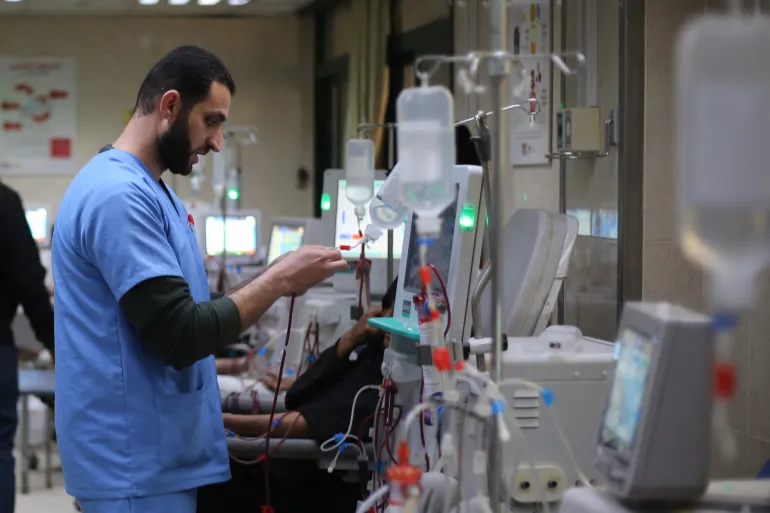
Omar al-Ghariz, an engineer specializing in power systems at Al-Aqsa Martyrs Hospital, said the generators had been overloaded for months, exceeding their capacity. „The electric generators at Al-Aqsa Martyrs Hospital have been operating continuously for many months under a load exceeding their normal capacity, due to their total reliance on them amid continuous power outages,” he told Al Jazeera. „[This] has led to significant wear and tear on many generator components and a noticeable increase in technical failures.”
Shortages of fuel and spare parts have forced the hospital's maintenance staff to rely on temporary solutions to keep generators running, but these may only delay the inevitable as the machines struggle under 24/7 operation.
„The biggest risk lies in the fact that the hospital depends on a limited number of generators to operate vital departments. Any sudden failure or fuel shortage could lead to the suspension of essential services,” he said. „Therefore, we urgently need new generators, spare parts and immediate technical support to ensure the continuity of hospital operations.”