Utolsó frissítés: 2026.06.14. — Szerző: Anti-Propaganda News Blog
„Welcome to Hell: A Report on the Treatment of Palestinian Prisoners in the Israeli Prison System and Torture Camps”
In July 2024, B’Tselem published the Welcome to Hell entitled *The Treatment of Palestinian Detainees*, which addressed the treatment of Palestinian detainees and their detention in torture camps under inhumane conditions. The report presented the testimonies of 55 Palestinian men and women who had been held in Israeli prisons and detention facilities since October 7, 2023. The testimonies revealed the results of a hasty process in which Israeli prison facilities—both military and civilian institutions — have been transformed into a network of camps specialized in the abuse of detainees, which is now official policy. Anyone who enters such a space is condemned to severe, deliberate, and relentless pain and suffering, de facto functions as a torture camp.
This update reviews the situation of Palestinian prisoners held by Israel through early January 2026.
The transformation of Israeli prisons into torture camps for Palestinian prisoners must be understood in the context of Israel’s coordinated campaign against the Palestinians, which has been ongoing since October 2023 and is most strikingly manifested in the ongoing genocide in Gaza. The foundations of the regime that enable the genocide in Gaza, the unchecked violence and ethnic cleansing in the West Bank, and the persecution of Palestinian citizens of Israel are the same ones that also determine the treatment of prisoners. First and foremost among these is the dehumanization of Palestinians as a group and the extreme violence used against them (for further reading, see B’Tselem’s July 2025, Our Genocide (entitled *Report*).
This update revises the categories of abuse listed in the original report, using them to assess the current situation and new developments. The report is based on the testimonies of 21 Palestinians who were released under an agreement reached between Israel and Hamas in October 2025 or in the preceding months. Many released prisoners are too afraid to testify, as —according to the witnesses we interviewed—Israeli authorities threatened anyone who shared information about their experiences in prison with re-arrest. These threats were made both before and after the prisoners’ release, illustrating how Israel uses deprivation of liberty as a key tool for the oppression of Palestinians.
Efforts to silence released prisoners are one aspect of a multifaceted policy pursued by Israel’s apartheid regime to dehumanize Palestinians and deny their humanity as a collective, whether through imprisonment and torture, or intimidation, political repression, and censorship.
This update also draws on several other sources, including recent research and reports from human rights organizations that regularly monitor conditions in Israeli prisons, media reports, data from the Israel Prison Service (IPS), and materials attached to petitions filed with the Israeli Supreme Court.
Taken together, these findings lead to an unambiguous conclusion: Israel continues its systematic, institutionalized policy of torturing and abusing Palestinian prisoners, a policy that is endorsed and supported by the political system, the judiciary, the media, and, of course, the prison authorities themselves; and even openly boast about the torturous conditions under which Palestinian prisoners are held.
A prime example of this is the series of PR materials jointly promoted by Itamar Ben-Gvir, the minister responsible for the prison system, and the IPS press office, which offers „a rare glimpse” into the prison blocks where Palestinians are held under inhumane conditions (see „Rakefet Wing,” p. 13). In these materials, Minister Ben-Gvir and IPS officials put the abuse of prisoners on public display, while the media acts as a mouthpiece for the minister’s violent and racist ideology, offering little or no criticism of the crimes and grave human rights violations contained therein.
Far from being carried out in secret, this systematic abuse is carried out in full view of the public, without any attempt to conceal or obscure it. In fact, those responsible openly boast about it, and the entire Israeli regime is complicit. Therefore, this report (and others) does not serve the purpose of „exposing” inhumane conditions—these are conditions that have been known and normalized in Israeli public opinion over the past two years. Although the abuse is evident and well-documented, international actors have so far refrained from effective intervention, which is yet another factor enabling the continuation of systematic torture. The torture of Palestinian prisoners—all of whom are labeled „terrorists” by the Israeli media—has become an accepted norm.
In light of this reality, we once again call on all states, bodies, and international institutions to do everything in their power to immediately end the cruel treatment and torture of Palestinian prisoners in the hands of the Israeli regime. Given the gravity of these crimes, the international community has a duty to insist that Israel be held accountable and to ensure that those responsible are brought to justice.
Key Findings
Based on B’Tselem’s ongoing documentation and monitoring, from the start of the war in October 2023 through the beginning of January 2026:
-
Deaths: 84 Palestinian prisoners and detainees (including one minor) have been identified by name as having died in Israeli prisons or detention facilities. Other human rights organizations and media outlets have reported even higher figures—at least 94 deaths—including those whose identities are unknown. As of August 2025, at least six Palestinians have died during interrogations by the ISA (Shin Bet).
-
Sexual assault: Testimonies from released prisoners attest to severe sexual violence in prisons and detention facilities. This ranges from forced strip searches and threats of sexual violence to actual sexual assault. This includes genital beatings causing serious injuries, setting dogs on prisoners, and forced anal penetration with various objects.
-
Institutionalized violence: Prisoners are subjected to frequent, organized, and institutionalized violence on an ongoing basis: they are subjected to electric shocks, tear gas, and stun grenades; cigarette butts are stubbed out on their bodies or hot liquids are poured on them; rubber-coated metal projectiles are fired at them, they are beaten with rubber batons, and dogs are set upon them.
-
Inhumane conditions: Living conditions for detainees remain inhumane: extreme overcrowding, prolonged shackling, prohibition of contact with the outside world, deliberate starvation, poor-quality food, and denial of basic hygiene conditions (personal hygiene, clean clothing, drinking water). Conditions in the „Rakefet Wing,” a completely underground section of Ramla Prison, are particularly cruel.
-
Denial of medical care: Denial of medical care remains a form of torture that leads to irreversible damage—ranging from loss of sight or hearing to amputation—and even death. Scabies is spreading like an epidemic in the facilities because the disease is not being treated properly and is constantly infecting other detainees.
How many prisoners and detainees are currently in Israeli custody?
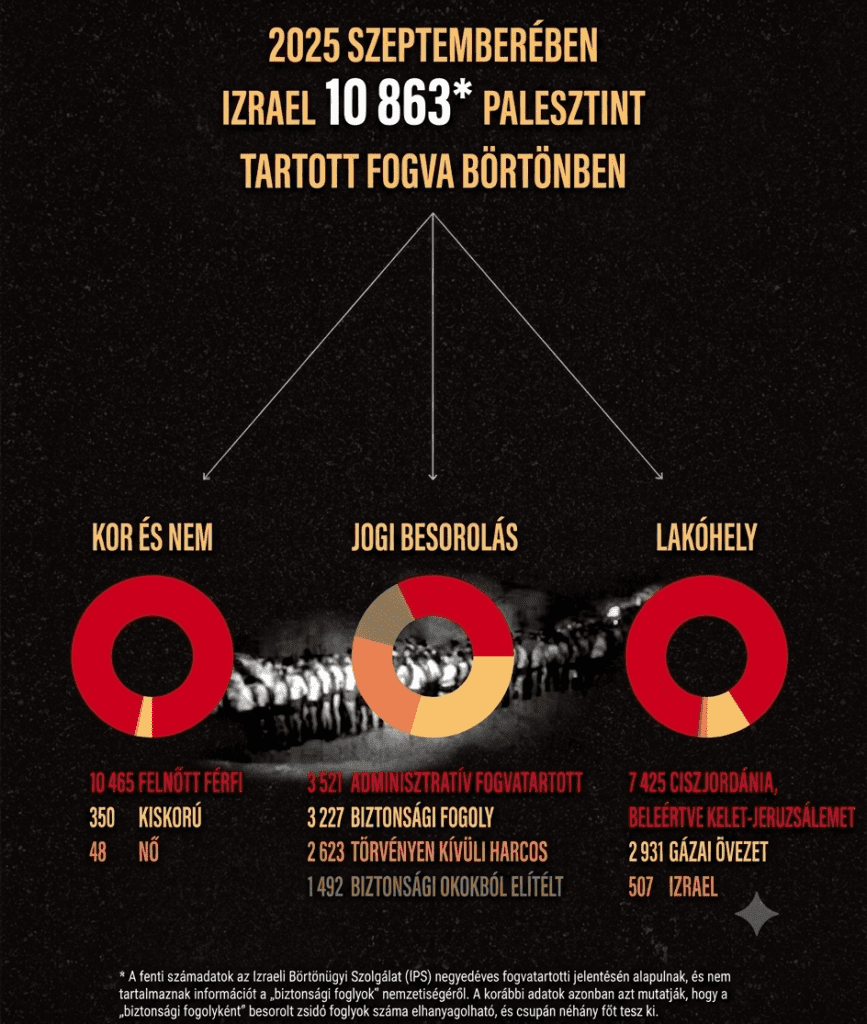
According to the quarterly prisoner report published by the IPS (Israel Prison Service) quarterly prisoner report, in September 2025 the IPS was holding 10,863* Palestinians whom the Israeli regime classified as „security prisoners.”.
Of these, 7,425 were from the West Bank (including East Jerusalem), 2,931 were residents of the Gaza Strip, and 507 were Israeli citizens. Of these detainees, 3,521 were „administrative detainees” (Palestinians held without trial and without the opportunity to defend themselves against the charges), 1,492 are „security prisoners” (Palestinians serving sentences based on court convictions), 2,623 are „outlaws” (Palestinians from Gaza detained without trial), and 3,227 „security detainees” (Palestinians facing criminal proceedings but not yet convicted). According to the report, 350 of the Palestinian detainees were minors and 48 were women.
Although Israel classifies Palestinian detainees into the categories detailed above, this report focuses on the inhumane conditions under which they are held. Accordingly, in this report, the term „Palestinian detainees” includes prisoners classified by the state as „security prisoners,” remand detainees, „outlawed combatants,” and „administrative detainees.”.
In October 2025, following the release of the latest IPS quarterly report, approximately 2,000 Palestinian prisoners were released as part of the „ceasefire agreement” between Israel and Hamas. Of these, 1,700 were adults and 22 were minors from the Gaza Strip who had been arrested after October 7, 2023. This indicates that even after the prisoner exchange, the number of Palestinians held in Israel remains significantly higher than before the war: an estimated 9,000 (at the end of September 2023, the total number of Palestinian detainees from the West Bank—including East Jerusalem—and the Gaza Strip was 4,935).
Deaths in Custody
According to B’Tselem’s ongoing monitoring and documentation, from the start of the war through December 2025, 84 Palestinian prisoners (including one minor) whose identities are known died in Israeli prisons and detention facilities. Of these, 50 were residents of the Gaza Strip, 31 were from the West Bank, and 3 were Palestinian citizens of Israel. Israel has so far released only four bodies and continues to withhold the remaining 80. As part of its efforts to conceal crimes committed in detention facilities, Israel frequently obstructs reliable autopsies, thereby preventing the clarification of the circumstances and causes of death of dozens of detainees for whose safety and health it is responsible.
A Physicians for Human Rights-Israel Its report, published in November 2025—which also includes Palestinian prisoners whose identities are unknown — provides verified information on 94 Palestinians who died in Israeli custody by the end of August 2025. The Haaretz According to a report, at least six Palestinians have died during interrogations by Shin Bet (ISA) as of August 2025. These figures include only those Palestinians known to have been arrested. The fate of the hundreds of Palestinians in Gaza who were taken into custody by the military but for whom there is no confirmation that they were imprisoned remains unknown. This raises concerns that the figures above underestimate the actual situation.
Sexual, physical, and psychological abuse
Sexual and gender-based violence
Several recently released prisoners who spoke with B’Tselem reported that they had suffered or witnessed sexual violence during their detention. Their testimonies describe sexual harassment, threats of sexual assault, forced nudity, severe injuries to the genitals caused by beatings, attacks by dogs, and forced anal penetration with various objects. In addition, testimonies submitted to the UN Committee Against Torture (CAT) reported sexual harassment of minors, electric shocks to the genitals, and the production of humiliating videos of a sexual nature. A recent BBC investigation also presented testimonies regarding sexual abuse of Palestinian prisoners by Israeli prison guards.
From witness statements:
-
„During the torture, one of the soldiers raped me. He shoved a piece of wood into my anus, left it there for about a minute, then pulled it out. Then he shoved it back in, even harder, and I screamed at the top of my lungs. A minute later, he pulled the piece of wood out again, told me to open my mouth, shoved the stick into my mouth, and forced me to lick it.” – Tamer Qarmut, 41, a father of five, is from Beit Lahiya in the northern Gaza Strip. He was held at the Sde Teiman detention center and the Negev (Ketziot) prison, and was released on October 13, 2025.
-
„One of them [the guards] sat on my back, another stomped on my head, and the third tried to shove something hard into my anus. I tried to tense my muscles and resist, but they managed to push it in. The pain was excruciating, and I screamed, but they repeated this six times. Then I felt them pour some kind of liquid on my backside; I don’t know what it was. All three of them laughed and mocked me while they assaulted and raped me.” – Sami a-Sa’i, a 46-year-old father of six from Tulkarm in the West Bank. He was held at Megiddo Prison and released on June 10, 2025.
-
„I endured the hardest days of my life at the Sde Teiman facility. I still suffer from severe trauma. They kept me naked, and the soldiers set dogs on me, which attacked me. They beat me on my penis and tied it with a plastic cord, which caused swelling and bleeding.” – Testimony of S.S. He was detained at the Sde Teiman detention center, Ofer Prison, and Negev (Ketziot) Prison, and was released on October 13, 2025.
-
„I saw prisoners who had been sexually assaulted. Some of them were attacked by dogs in their private parts and required emergency surgery afterward. Some prisoners were bleeding from their rectums and urethras. One of them had to undergo amputation due to neglect and denial of medical care.” – Ibrahim Fuda, 35, a father of two, is from Beit Lahiya in the northern Gaza Strip. He was held at the Negev (Ketziot) Prison and was released on February 14, 2025.
Physical violence and intimidation
Palestinian prisoners continue to be subjected to severe physical violence and systematic, institutionalized abuse. Prisoners who were recently released and who spoke to B’Tselem reported a continuous routine of severe violence, including electric shocks, the use of tear gas and stun grenades, extinguishing cigarettes on prisoners’ bodies, pouring hot liquids on their bodies, firing rubber bullets, beating with batons, and setting dogs on them. This violence caused serious injuries, loss of consciousness, vision and hearing impairment, broken bones, internal bleeding, bloody urine, and other injuries among the detainees.
Testimonies provided to B’Tselem and reports by human rights organizations show that violence and brutal attacks are part of daily life in prisons and detention facilities: at the time of arrest, upon arrival at the facility, when entering and exiting cells, during roll call, during rare visits to the clinic, and before and after court hearings (for further details on physical and psychological abuse, see the Welcome to Hell report, p. 44). A series of testimonies given to B’Tselem attest to severe torture during interrogations:
„The soldiers arrested me and took me naked to a nearby building [near al-Shifaa Hospital], which the army had seized and turned into a military post. They tied my hands, covered my eyes with a piece of cloth, and left me naked. […] During the interrogation, the soldiers stubbed out cigarettes on my body, poured hydrochloric acid on me, and burned my back with a lighter. I lost sight in my left eye due to the burns.” – Muhammad Abu Tawilah, a 35-year-old father of one from the as-Shuja‘iyah neighborhood in Gaza City. He was held at military detention centers in Gaza and at Ofer Prison, and was released on February 15, 2025.
Other testimonies describe particularly brutal acts of torture carried out during interrogations in a room referred to as the „disco room”:
„They took me to a room for the interrogations that they called the ‘disco’ room. For six days, I was given only a capful of water to drink each day, and I ate only a cucumber and a piece of rotten bread that the soldier had stepped on before handing it to me. They beat me nonstop, and from time to time I was given electric shocks. I sat on a metal chair from morning till night. Outside the room was a huge speaker blasting Hebrew songs at an unbearable volume; my eardrums burst and my ears bled. There was no bathroom in the room, so I urinated in my clothes.” – Testimony of S.S.. He was detained at the Sde Teiman detention center and at Ofer and Negev (Ketziot) prisons, and was released on October 13, 2025.
Testimonies collected for a report submitted to the UN Committee Against Torture (CAT) by the Israeli Committee Against Torture and other organizations document severe violence during Shin Bet interrogations. This includes stress-inducing restraints (e.g., the „banana” position or prolonged squatting), suspension by the wrists, limb stretching, sleep deprivation, „freezing” rooms, and confinement in filthy, insect-infested cells under constant artificial lighting. Loss of consciousness, broken teeth, internal bleeding, muscle tears, bloody urine, loss of the ability to eat independently, and temporary numbness in the limbs are just a few of the documented consequences of the interrogations. Some detainees reported that they were unable to move on their own after the interrogation.
A Physicians for Human Rights-Israel According to data published in the same report—which is based on visits conducted between October 7, 2023, and June 30, 2025—76% of the Palestinian prisoners suffered severe violence upon arrest, 65% experienced at least one serious incident of violence within the detention facility, and 44% suffered long-term injuries or health problems as a result of this violence.
Abuse of minors
In September 2025, Israel was holding 350 minors in custody. The Defense for Children International-Palestine in a report submitted to the CAT in November 2025—which is based on 325 sworn statements collected from Palestinian minors detained in the West Bank—found that 74% of the detained minors had been subjected to violence, 26% were interrogated under pressure, and 21% were placed in solitary confinement for two or more days as a means of exerting pressure during interrogation.
In March 2025, Walid Ahmad, a 17-year-old Palestinian who was being held at Megiddo Prison, died as a result of starvation and the denial of proper medical treatment. Ahmad is the first minor to have died in an Israeli prison facility since October 7, 2023, and as of January 2026, Israel is still withholding his body.
Humiliation, verbal and psychological abuse
Testimonies from Palestinian prisoners reveal the systematic use of humiliation and psychological abuse as forms of torture aimed at breaking their spirit. Released prisoners have reported being filmed naked, forced to „apologize” for crimes they did not commit, and to sing „Am Yisrael Chai,” subjected them to severe insults directed at them and their families, and threatened their family members with physical and sexual harm. In other cases, detainees reported that soldiers spat on them or urinated on them. In several testimonies collected by B’Tselem, psychological abuse was described as part of an attempt to recruit collaborators:
„During the interrogations, the interrogators tried to convince me to cooperate with them. They promised me new clothes and food, but I refused. They told me they had killed my entire family, which had a profound effect on me. I wanted to die.” – Ibrahim Fuda, a 35-year-old father of two from Beit Lahia (Northern Gaza). He was held at Negev (Ketziot) Prison and was released on February 14, 2025.
Detention procedures
Inhumane living conditions
As of the end of September 2023, Israel was holding 4,935 Palestinians in prisons (2,222 of whom were convicted prisoners). By September 2025, their number had more than doubled to 10,863 (including 1,492 convicted prisoners). This dramatic increase has led to inhumane overcrowding in cells, in line with a stated policy of deliberately worsening conditions for Palestinian detainees. For example, many prisoners were forced to sleep on the floor, even in winter, often without a mattress or blanket.
Recently released prisoners have reported being held in filthy cells—sometimes in complete darkness— sleep deprivation, prolonged handcuffing of hands and feet (even while showering and using the toilet), as well as prolonged squatting and being kept blindfolded, which sometimes lasted for the entire time spent in prison:
„Since our hands were tied very tightly the whole time, the zip ties started to cut into our skin and flesh at the wrists. It bled constantly until, at one point, the bones were visible on both my hands. It was a constant, sharp pain. When my condition worsened, the soldiers took me to a place where a female doctor treated me. It took her an entire day to drain the infected blood and clots from my fingers using the most primitive medical tools.” – Tamer Qarmut, a 41-year-old father of five from Beit Lahiya (Northern Gaza). He was held at the Sde Teiman detention center and the Negev (Ketziot) prison, and was released on October 13, 2025.
The released prisoners also reported inhumane living conditions, such as being regularly kept in cold and damp environments without access to showers, adequate clothing, or a change of clothes:
„They barely let us take a shower, and when they did, it was only for two minutes. We didn’t take those tracksuits off for more than two months. Our clothes got so dirty that we had to wash them, and then we had to put them back on while they were still wet, even in the winter cold.” – Muhammad al-Mishwakhi, a 45-year-old father of seven from Rafah (southern Gaza). He was detained at the Sde Teiman detention center and released on October 13, 2025.
The „Rakefet” Wing
Particularly noteworthy for its inhumane conditions is the Rakefet Wing at Ayalon Prison (formerly Ramla Prison), which is located entirely underground and never sees sunlight. The wing was closed in the 1980s due to allegations of inhumane conditions, and was then reopened by Minister Ben-Gvir at the start of the October 2023 war. The minister used the extreme conditions of torture prevailing in the wing as a cynical PR tool to intensify the dehumanization of Palestinian prisoners, both there and in other facilities. According to reports by human rights organizations, prisoners held in the Rakefet wing report systematic violence, including violent, unexpected searches of cells and psychological abuse such as the display of posters depicting the destruction of Gaza.
Refusal to maintain contact with the outside world
As part of its denial of Palestinian prisoners„ rights, the Israeli regime is working to isolate them from the outside world and prevent oversight of their conditions of detention. Under this policy, family visits have been completely suspended since October 2023, and access has been denied to representatives of the International Committee of the Red Cross, whose role is to monitor detention conditions. Prison authorities are placing obstacles in the way of Palestinian prisoners who wish to meet with their lawyers; for example, they systematically cite ”security concerns” regarding the lawyers to justify denying them entry, and even ban them from the prisons for extended periods.
Thus, in addition to constituting a serious violation of the right to legal representation, the denial of visits by lawyers also severely undermines the families’ ability to receive news about their loved ones. This heightens anxiety and uncertainty regarding the prisoners’ fate, which is only exacerbated by reports of abuse and torture in Israeli prisons that have been emerging since October 2023.
According to human rights organizations that provide legal counsel to Palestinian prisoners, another worsening trend is the deliberate obstruction of lawyers„ work and the serious, systematic violation of attorney-client confidentiality. Lawyers have reported that prison guards prevent them from bringing legal materials into meetings, allowing only blank paper and pens. Any written materials brought by lawyers are meticulously searched by guards, even if they are protected by legal confidentiality; sometimes this is used as a pretext to deny a visit and bar the lawyer, on the grounds that they ”conveyed messages.” There was a case where a lawyer was barred after bringing photographs of his children to a Palestinian prisoner at Ofer Prison. There are also numerous reports that guards remain present throughout the entire meeting with the lawyer, which makes it difficult for prisoners to consult freely. The lawyers stated that even when prisoners show clear signs of violence or denial of medical treatment on their bodies, they do not dare to mention this in the presence of guards out of fear of retaliation.
Denial of basic living conditions
Denial of medical care
A Physicians for Human Rights According to an analysis by Physicians for Human Rights, there is evidence that the denial of medical care, along with other forms of torture, has systematically led to the deaths of Palestinians in Israeli prisons and detention centers. Based on the results of 10 autopsies performed on Palestinians who died in the custody of the IPS (Israel Prison Service) since October 7, 2023, the denial of medical care was documented in six out of ten cases.
In a report submitted to the Committee Against Torture (CAT) in a report submitted in November 2025, several human rights organizations stated that they had documented numerous cases in which Palestinian prisoners suffered irreversible health damage due to the deliberate denial of medical care. Among others, doctors serving at the temporary hospital set up at the Sde Teiman military detention facility testified to limb amputations resulting from violence, prolonged shackling, and a lack of proper medical treatment. According to their testimony, all patients in the hospital were kept blindfolded and handcuffed at all limbs, even during medical treatment. The restraints also prevented them from using the toilet, forcing them to relieve themselves in diapers. Additional testimonies collected by B’Tselem reported untreated severe injuries and chronic illnesses, as well as cases of limb amputation.
„The day after we arrived in Sde Teiman, I began to feel excruciating pain in my leg. I gradually lost the ability to stand. […] On March 14, 2024, I woke up to find myself lying in a large pool of blood. I went into shock. I looked at my legs and saw that they were bleeding. It was a horrific sight; I began screaming and crying hysterically, hoping that someone would come to help me. They took me to the prison hospital. I heard the doctor tell the soldiers that I had suffered severe blows to my kidneys, which had also caused the wounds on my legs. I stayed in the hospital for 10 days, and they performed seven surgeries on my legs. During that time, I was handcuffed and blindfolded the whole time. I was tied to a bed and couldn’t move or walk at all. […] About a week later, a doctor in uniform told me: ‘Listen, your life is in danger. You have to choose: either we amputate both your legs, or you die.’ I started crying and screaming, hoping that someone would hear my pain, my agony, my grief. They handed me a document and forced me to sign it, agreeing to the amputation of both my legs.” – Jibril al-Safadi, a 45-year-old diabetic father of six from Khan Yunis in the southern Gaza Strip. He was held at the Sde Teiman detention center, as well as at Ofer and Nafha prisons, and was released on October 13, 2025.
Additional testimonies submitted to the CAT indicate that Palestinian female prisoners are not provided with menstrual hygiene products and do not have access to gynecological care, and that pregnant women are also denied such care.
Due to starvation, poor-quality food, extreme overcrowding, the denial of basic living conditions and hygiene, and the lack of medical care, the health of nearly all Palestinian prisoners has deteriorated during their detention. One particularly striking example of this is the spread of scabies. In November 2024, it was reported that approximately one-quarter of Palestinians in IPS custody had been diagnosed with scabies.
The disease continues to rage. A message sent on November 5, 2025, from the Negev (Ketziot) Prison on November 5, 2025, in a message sent to a lawyer who wanted to visit a prisoner, noted that „all inmates in Blocks A/B/C require treatment for scabies.” For this reason, entry to the prison was prohibited, and the lawyer was unable to meet with his client. The Doctors for Human Rights According to information provided to the organization, there were 1,437 patients with scabies in all prisons in November 2025, though this figure is likely a significant underestimate.
Another example of the spread of infectious diseases due to inhumane conditions is the infectious intestinal disease diagnosed among Palestinians at Megiddo Prison, which led to extreme weight loss.
Denial of food and starvation
In response to a petition regarding the policy of starvation against Palestinian prisoners, filed with the Supreme Court in April 2024 by the Israeli Civil Rights Association and Gisha, Minister Ben-Gvir stated: „My policy is to reduce the conditions of security prisoners to the minimum required by law, including food and calories.”
It was not until September 2025—about a year and a half after the petition was filed, while the prisoners continued to suffer from a deliberate policy of starvation— did the Supreme Court accept the petition and determine that there was indeed a risk that the feeding of Palestinian prisoners did not adequately ensure compliance with legal requirements. Despite the Supreme Court’s ruling, reports from human rights organizations and the media indicate that—beyond receiving slightly larger portions—Palestinian prisoners continue to be deliberately starved. Testimonies given to B’Tselem largely described a diet consisting of sliced bread, poor-quality, meager food, weight loss, and a constant feeling of hunger:
„Most of the time I was hungry because they gave us very little food, and what we did get was bad. Sometimes the bread was moldy. I remember that after seven months in detention, they brought us a bucket of tea that had cockroaches in it, and of course we didn’t drink it.” – Tamer Qarmut, a 41-year-old father of five from Beit Lahia (Northern Gaza). He was released on October 13, 2025.
The testimonies also mentioned the lack of clean drinking water: „They cut off the water supply, and when it was restored, it was only for an hour. We had no choice but to drink contaminated water. We collected water in the folds or lining of the tent, and sometimes we had to drink from the toilet tank.” – Ibrahim Fuda, a 35-year-old father of two from Beit Lahia (Northern Gaza). He was released on February 14, 2025.
Original report PDF.