Utolsó frissítés: 2026.06.29. — Szerző: Anti-Propaganda News Blog
Residents of two unrecognized Palestinian villages have been forced to demolish their homes by themselves – the latest chapter in a decades-long cycle of displacement.
Oren Ziv, June 24, 2026.
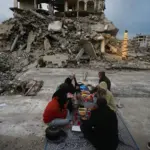
Farhan Al-Nabari sat next to some discarded mattresses and furniture, staring at the spot where his home had stood just days earlier. „This is a catastrophe,” the 75-year-old told +972 Magazine on June 14, pointing to the rubble. „We already experienced a Nakba [catastrophe] in 1952, when we were driven from our lands around Lakiya, and now this is the second Nakba.”
In the space of a week, Farhan became one of about 200 Al-Nabari families in the unrecognized village of Tel Arad in the Negev (Naqab) desert who were forced to demolish their homes themselves, following a 2025 Israeli court ruling ordering the evacuation of the area. They did this to avoid the heavy fines and police raids that often accompany state demolitions in unrecognized Israeli villages.
The eviction is the latest chapter in decades of uprootedness. In 1952, four years after the Negev came under Israeli control, the Israeli military government expelled the Al-Nabari family from the village of Lakiya and resettled them in nearby Tel Arad. Since then, they have lived there without official recognition or basic infrastructure, building hundreds of houses. The area, now home to about 3,500 residents, was formerly inhabited by members of the Jahalin tribe, who were also evicted in 1948; many of them now live in the „E1” corridor in the West Bank, between Jerusalem and Jericho, where the state is once again working to evict them.
„We hired lawyers to try to stop [the demolitions], and we went through a long legal process until we got to this point,” Rashid Al-Nabari, son of Farhan, the last resident in the neighborhood to begin demolishing his house, told +972. „These homes have been here for 70 years. The hand that signed this ruling should have trembled.”
Residents were originally scheduled to complete the demolitions and evacuations by June 10. After inspectors from the Israel Land Authority (ILA) conducted a site inspection, authorities granted a short extension until June 14. Although the Al-Nabari neighborhood is the first in the village to complete the demolitions, residents expect other parts of Tel Arad to receive similar evacuation orders in the near future.
Since the current government took office, the number of demolitions in the Negev has increased dramatically. According to figures from the Israeli Ministry of National Security, authorities demolished 5,742 „illegal structures” in the region in 2025, up from 2,850 in 2022. More than 1,000 of these were residential buildings. In contrast, only 40 families were given plots of land to move to through the Israeli Bedouin Settlement Authority.
„"Home is a whole world"”
From the state's perspective, the increase in self-demolition is considered a success. When residents demolish their homes themselves, authorities avoid the costs of demolition and the heartbreaking public spectacle of forced evictions.
During the demolition operation in the unrecognized village of A-Sir last September, hundreds of police, horsemen, off-road vehicles, rubber bullets were present, and residents set fire to their own homes in protest. The confrontation received widespread coverage in the domestic and international media. This week, when residents of A-Sir and Tel Arad again demolished their homes by hand, only a handful of journalists attended.
These demolition campaigns often wipe out entire communities. According to the Bedouin Settlement Authority, some 90 residential areas have been cleared in the past two years. Umm Al-Hiran, Wadi Al-Khalil, two neighborhoods in Umm Matanan, and a third of A-Sir have been completely destroyed.
„It’s an incredibly difficult feeling,” said Rashid Al-Nabari. „Home is a whole world; a roof over your head, safety, and now there’s no home and no solution.”
The demolitions have upended almost every aspect of life in Tel Arad, including education. The village school, which consists of several mobile homes and normally serves 450 students along with several kindergartens, has been closed indefinitely since the demolitions began. About 80 students and four staff members have lost their homes. „There is no time for education now,” complained Rashid Al-Nabari.
One reason for the closure is that the school has become a temporary shelter. Classrooms have been converted into sleeping quarters, lined with mattresses, for women and children, including a one-month-old baby. During the day, the mattresses are moved aside to make room for makeshift kitchens. The men sleep outside, under trees.
„I think of the children before anyone else,” said Farhan Al-Nabari. „During the demolition, when a child sees their father or brother destroying their own home, it hurts them.”
Residents were ordered by the ILA to leave the area clean, which meant removing debris and cutting down decades-old trees or face fines. They refused to destroy the trees, but with the help of hundreds of Bedouin volunteers from all over the Negev, they spent days salvaging building materials, hauling away debris, and removing belongings from demolished homes. In some cases, residents set fire to the remaining ruins.
Shared community
The state's proposed solution would relocate Tel Arad residents affected by the demolitions to newly planned Bedouin communities, but many fear it will tear apart a community that has existed for generations.
Some families are expected to move to Marva, a new Bedouin village that will contain 1,000 housing units. Marva is one of five new rural communities planned as part of the 2024 „Mevo'ot Arad” development plan. The other four are intended for Jewish residents. On June 11, the government approved 180 million shekels (more than $60 million) to advance the project.
But Marva can only accommodate a fraction of Tel Arad's population. The rest of the residents are expected to move to Mara'it, another planned community two kilometers away, effectively splitting the close-knit community in two.
„The state evicted me from my land [in Lakiya] in 1952, but then they gave us alternative land,” said Farhan Al-Nabari. „But now there is no alternative – nowhere to go. They are offering unacceptable solutions, such as living in a quarry [next to the planned Mara’it village].”
The plan, which has been opposed by environmental groups, urban planners and, initially, even the municipality of the predominantly Jewish city of Arad, follows the government's 2022 decision to authorize the ultra-Orthodox city of Kasif near the Tel Arad junction, and is part of a broader effort to Judaize the northern Negev.
According to a document prepared by Bimkom, an Israeli NGO that deals with planning rights, existing regional zoning plans would technically allow for the recognition of Tel Arad or the expansion of Marva, allowing the community to stay together instead of dispersing its families across multiple settlements.
„The thousands of residents of Tel Arad function as a community in every sense,” said Dafna Sporta, head of the Bimkom Negev branch. „Instead of acting fairly and equally and settling the situation of the community, which wants to stay together in the village, the state decides to liquidate it and establish four Jewish villages for people who have never lived a single day on this land.”
„This is a political decision to create a Jewish settlement bloc, as if Bedouin citizens were not part of the State of Israel,” he said.
The urgency of the demolitions is particularly difficult for residents to grasp, as the alternatives are largely theoretical. Construction on Mara'it has not yet begun, nor has construction on the Jewish villages planned for the area. As in A-Sir and other recent cases in the Negev, residents are being required to demolish their homes and leave before any actual new housing is provided.
The planned Jewish housing will fall under the Tamar Regional Council. Marva, on the other hand, falls under the Al-Qasum Regional Council, whose jurisdiction essentially consists of isolated „islands” scattered throughout the Negev.
Sporta stressed that the residents of Tel Arad are willing to compromise with the state, including agreeing to expand Marva. „Expanding Marva is the right and just thing to do,” he said. Instead, he added, the state „wants to Judaize the area while completely ignoring the people who already live there.”
„"The Eighth Front"”
On Tuesday afternoon, June 16, residents of A-Sir also demolished about 20 of their own homes. Like the families in Tel Arad, many of the residents of A-Sir have lived in the area for decades. After being settled there by Israeli authorities in the 1950s, they spent nearly 80 years building a community. This week, two hired bulldozers, paid for by the residents themselves, reduced part of the village to rubble in a matter of hours.
„We are demolishing it so we don’t get fined,” said Nasser Al-Afshak, a resident in his 40s. „It feels terrible. I have children who are going to university, and instead of studying, they are evicting us. I will live in a tent, just like my grandparents did here.”
A-Sir, located on Highway 40 between Be'er Sheva and Tel Arad, became a symbol of the struggle against demolitions last year. The self-demolition of dozens of homes, including that of the late Knesset member Sa'id Al-Harumi, led to mass protests in front of government offices, courts, and the Bedouin Settlement Authority headquarters in Be'er Sheva. These demonstrations largely subsided after the war with Iran last June, but the demolition policy continued.
„Ben Gvir wants to destroy lives, not houses,” Al-Afshak said as she and her seven sons evacuated three family homes, including one that had been built only six months earlier. „[The authorities] don’t care where we go. I told them we have nothing to rent, and they said, »That’s not our problem,«” she recalled. „I just want a place to live.”
Some families whose houses were demolished months ago are still living in tents amid the ruins. Only one housing complex in the Al-Afshak area has received official government permission to remain. Development is planned in the area, with plans to turn it into a new quarter for the Bedouin town of Segev Shalom (Shaqib A-Salam), which is supposed to provide housing for the displaced residents. But residents say the development process is moving at a snail’s pace. They say the state has been pressuring families to demolish their own homes much faster than it has been offering viable alternatives.
The court cases involving the Al-Afshak family last year illustrated the gap between demolition orders and available housing. At a hearing in November, lawyer Nawaf Abu Qweider, representing the family, asked Yigal Buskila, deputy director general for regulation at the Israeli Bedouin Settlements Authority, when the plots in the planned neighborhood would actually be ready for residents to move into.
„On this scale,” Buskila replied, „it could be between one and a half and two months,” while noting that the timeline still depends on permits, land allocations and signed agreements.
Following these assurances, the state agreed not to carry out any demolitions before early April, and the family withdrew their request to have the demolition orders lifted. Yet, seven months later, the Al-Afshak family was forced to demolish their home, despite the fact that they still had no clear alternative housing solution.
„The government is responsible for these demolitions,” said Atiya Al-Asam, president of the Regional Council of Unrecognized Bedouin Villages. „The government says it wants to wage war on seven fronts, but in reality it is waging war on eight fronts, and the eighth front is the Negev and the unrecognized villages.”
Activists hope the latest wave of demolitions will reignite public opposition to the policy. On Thursday, June 25, residents and their supporters will demonstrate outside the offices of the Israeli Bedouin Settlements Authority, demanding a halt to the demolitions and the provision of housing solutions before families are forced to leave their homes.