Utolsó frissítés: 2026.07.01. — Szerző: Anti-Propaganda News Blog
A reporter tells of the torture he endured in captivity, a near-fatal stroke, and his determination to bear witness.
Photos of Mujahid Bani Mufleh before and after prison shocked people – including him.
„It hurts to look at those photographs where I see the person I used to be,” said the prominent Palestinian journalist from the town of Beita, near Nablus in the occupied West Bank.
Six months of Israeli captivity without charge or trial changed him forever.
The 36-year-old father of three emerged from prison with a sunken face, sunken eyes, emaciated and weakened, looking years older than when he entered.
Apart from diabetes, Bani Mufleh was in good health before his arrest, but he claims months of torture, physical abuse and medical neglect have destroyed his body.
„My defenses collapsed under the weight of torture and humiliation,” he told Middle East Eye from his hospital bed. „They wanted you to forget who you were.”
Two days after his release on January 12, 2026, Bani Mufleh was hospitalized with a severe brain hemorrhage followed by a stroke, which he believes was caused by the abuse he suffered in Israeli captivity.
Doctors performed emergency surgery to remove part of his skull to relieve pressure on his brain, and he spent two months in a coma.
He remains in the hospital, facing a long and difficult recovery.
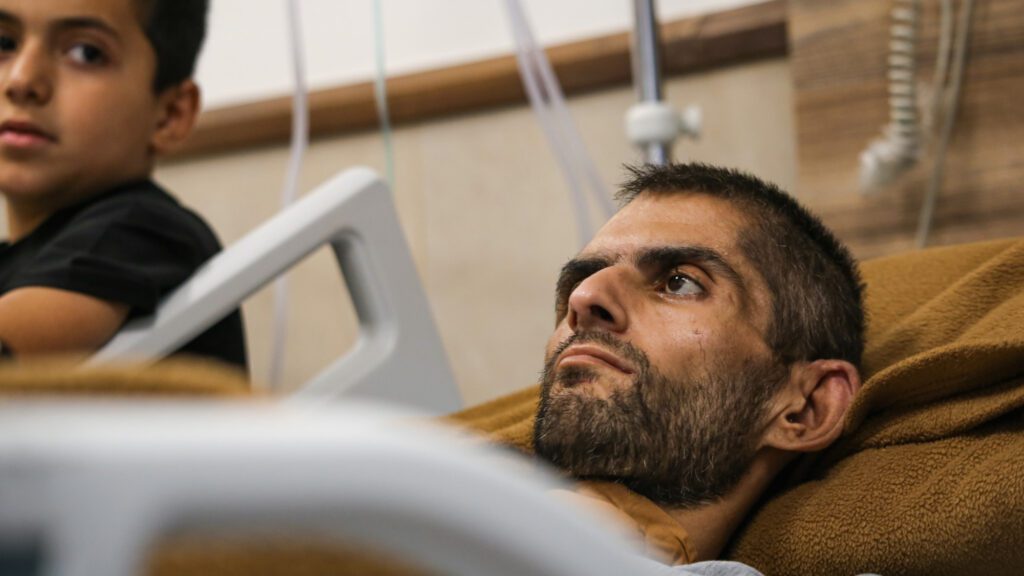
Mujahid Bani Mufleh is still in hospital, five months after his release from Israeli prison (Mojahid Nawahda/MEE)
Bani Mufleh, who has worked as a journalist her entire adult life, said that one thought kept her spirit going during her captivity: that one day she would be able to tell the stories of the people who were imprisoned with her.
But the torture and subsequent months of hospitalization deprived him of this opportunity.
„I never forgot that I was a journalist,” he said. „Throughout my captivity, I thought that one day I would tell the stories of those who could no longer speak for themselves.”
„"But time never gave me that chance. Before I could write about the tortured, I had a stroke. And instead of writing their stories, I became the story."”
„"His body couldn't take it anymore"”
Bani Mufleh was arrested on June 28, 2025, at his home in Beita.
He spent more than six months in Israeli administrative detention – a policy under which Palestinians can be imprisoned without charge or trial on secret evidence that neither the detainees nor their lawyers can examine. Detention orders can be renewed indefinitely, leaving prisoners uncertain when – or if – they will be released.
Bani Mufleh says he suffered psychological and physical torture, prolonged starvation, and medical neglect during his detention.
Months after his release, he is still recovering. His speech is slow and deliberate, each sentence punctuated by pauses as he searches for the words.
„I seem to have changed,” Mufleh said. „I can’t speak as clearly as I used to.”
As he slowly learned to speak again, he realized that regaining his voice also meant carrying the voices of his cellmates.
„I will never forget Samir al-Rifai, a man in his 50s,” he said. „Samir and I were taken to court together, and when we returned, they tortured us. His body couldn’t take what they were doing to him anymore.”
„Later, the guards burst into our cell and pepper-sprayed us. Samir collapsed. They took him out and he never came back. The next thing we heard, he was dead.”
Al-Rifai was not the only prisoner whose death left a deep mark on Mufleh's memory. Another was Ahmad Taza'zah, a 20-year-old detainee whose condition deteriorated rapidly after being abused in prison.
„I will never forget Ahmad Taza'zah, a young man only 20 years old,” Mufleh said. „During the torture, they set a dog on him and it tore his face apart. The wounds became infected and all he needed was a course of antibiotics.”
„During the torture, a dog was set on him, which tore his face apart” – Mujahid Bani Mufleh, Palestinian journalist
„Instead, they left him to suffer for days. He started vomiting constantly. Later, they took him out to the prison yard. He never returned alive.”
Despite all this, Bani Mufleh says he never stopped seeing himself as a journalist.
Although returning to reporting remains physically difficult, Mufleh says telling these stories has become part of his own recovery. The promise he made to the men he left behind in prison—to tell their stories—is a vow he remains determined to keep.
Israeli forces have arrested more than 20,000 Palestinians in the occupied West Bank and Gaza Strip since October 2023.
Human rights groups and press reports have documented systematic abuse of Palestinian detainees, including torture, starvation, medical neglect, and sexual violence.
At least 84 identified Palestinians, including a child, have died in Israeli custody under such conditions. Rights groups say the true death toll is likely higher.
Slow recovery
It's not just the memory of those who died in prison that haunts Mufleh. Amidst the violence and loss, she clings to one image from the outside world: the face of her young child, Arab.
„In prison, I tried to remember the face of my son, Arab, so that the faces of those who died behind bars wouldn’t consume me. But I could only recall one image of him – crying as Israeli soldiers arrested him in our home.”
„After they beat and tortured me, I looked at him as I lay on the floor. He was crying. That was the last image of him that remained in my mind.”
The memories of prison did not fade. They remained inseparable from the physical and psychological scars of his imprisonment.
Nuha al-Shurfa (left) and Mujahid Bani Mufleh with their three children at Ibn Sina Hospital in Jenin, in the occupied West Bank (Mojahid Nawahda/MEE)
His wife, Nuha al-Shurfa, says the changes are not only visible on his body, but also in the family's daily lives as they try to rebuild their lives after his return.
„"When Mujahid came home, it was as if our family had come back to life. He returned severely weakened, having lost about 25 kilos during his captivity," al-Shurfa told MEE.
„During his time in prison, despite being diabetic, he did not receive proper medical care. Seeing him improve – even if only little by little – gives us hope and strength to continue.”
He added that his condition remains fragile and he is far from fully recovered. He is still unable to drink most fluids and has struggled to even drink water for more than five months, fearing it would worsen his condition and damage his lungs.
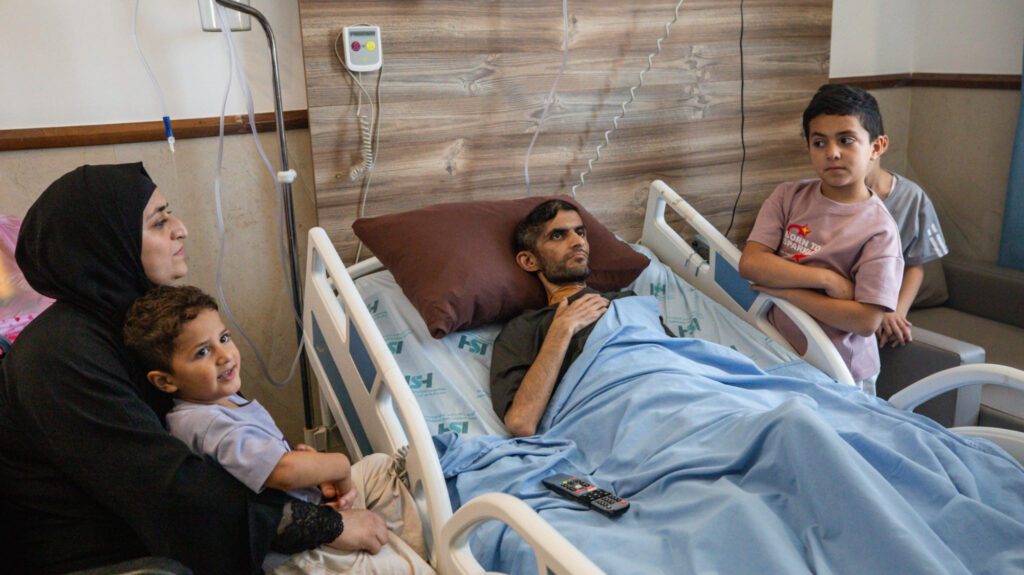
„We know that his recovery is far from over and he faces many challenges every day,” al-Shurfa said. „But having him back with us is something we are deeply grateful for and we are with him every step of the way.”
„"Life's Greatest Blessings"”
For his family, recovery is measured in small victories: a few more words he says without effort, another step he takes without help, or a day with a little less pain.
For Bani Mufleh, this experience also changed the way he sees the ordinary moments of everyday life.
„I learned how even a simple loaf of bread can become a dream” – Mujahid Bani Mufleh, Palestinian journalist
„During my captivity, I learned what true hunger felt like – waiting for meals that were never enough, going to bed with a sore stomach and waking up with the same feeling,” he said.
„I learned how a simple loaf of bread can become a dream, and how a sip of cold water can feel like a heavenly blessing.”
His recovery, he says, taught him a different lesson.
„During my recovery, I learned the meaning of helplessness – when getting out of bed becomes a struggle, taking a single step feels like an achievement, breathing without pain becomes a wishful thinking, and a peaceful night’s sleep a distant luxury.
Those months taught me that the greatest blessings in life are not the big things we once imagined. But the small, everyday moments we previously experienced without ever noticing them.”
Written by: Mojahid Nawahda and Teebah Assi, Jenin, occupied Palestine