Hard power tools are needed to stop Tel Aviv's reckless drive to redraw the borders of the Middle East.
The US government signed two contradictory agreements to end the war with Iran. It is now trying to regain the power that Israel lost in dictating the terms of peace with Iran in Lebanon. It has received enormous help in this from the Lebanese government, which has renounced both sovereignty over its country and its obligation to seek legal redress for war crimes committed by Israel.
Under the agreement signed by US President Donald Trump and Iranian President Masoud Peskov, Washington acknowledged the direct link between Iran and Lebanon and agreed to "an immediate and permanent cessation of military operations on all fronts, including Lebanon.".
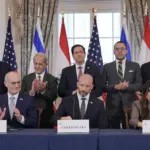
This commitment, if implemented, would nullify the second agreement signed in Washington on Friday between representatives of the Lebanese, Israeli and US governments. This „framework agreement” grants Israeli forces, who occupy a large part of southern Lebanon, permission to remain indefinitely.
In the first agreement, the United States promised to respect Iranian sovereignty, including over the Strait of Hormuz. In the second, its ally, Israel, did not commit to respecting Lebanese sovereignty, which was further weakened by the creation of a „military coordination group” led by Washington.
The agreement commits the Lebanese army — which Washington and Israel keep deliberately weak with veto power over the weapons they authorize — to disarm a battle-hardened armed group that many in Lebanon consider the only credible deterrent against Israeli attacks and settlers.
The framework agreement also obliges the Lebanese government to grant immunity to Israeli soldiers and generals for war crimes committed during the invasion. Legal experts say Article 13 deprives the Lebanese government of the right to file legal complaints against Israel in international courts.
The threat of civil war in Lebanon
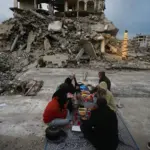
Since October 2023, more than a million people have been displaced in Lebanon and at least 8,000 have died. Several Israeli strikes have targeted civilians, including journalists and health workers.
According to Halima Kaakour, a Lebanese MP and international law expert, „this clause reflects the political decision of the Lebanese authorities not to act in international forums in exchange for the Israeli withdrawal – which is a fundamental right and should not be traded for anything.”.
The anger on the streets of Beirut was so great that Prime Minister Nawaf Salam was reportedly forced to thank Parliament Speaker Nabih Berri for calming the mood. Berri vowed to block the agreement to avoid a possible civil war. Given Lebanon’s history, this warning should not be taken lightly.
„Those who prepared this agreement want to incite fitna [civil strife], but I do not want that and I will do everything to prevent an explosion,” Berri said. „Even Hezbollah is working to restore internal calm, but they [the agreement’s supporters] insist on pushing through an agreement that is even worse than the May 17 agreement… they want fitna.”
Berri said the region could pay the price for what he called the „tug-of-war” within the US government.
As Lebanon’s main predator, Israeli Prime Minister Benjamin Netanyahu was delighted with the Washington agreement, dismissing as insignificant the two areas around the Litani River from which Israeli forces had promised to withdraw. Netanyahu also called the agreement a „serious blow” to Iran: „Iran is trying to force us out of southern Lebanon. In effect, Israel, Lebanon and the United States are telling them: this is none of your business.”
The two agreements are so different because two competing factions in the US government are fighting in the "tug of war" that Berri mentioned.
Trump’s Iran deal reflects the mindset of Vice President JD Vance, who felt vindicated by the complete failure of US-Israeli airstrikes that failed to achieve regime change. Vance made no secret of his opposition to joint strikes and was conspicuously absent from the briefing room in February when Trump, after briefing Netanyahu and David Barnea (then director of the Mossad), decided to go to war with Iran.
The rhetoric of the „Sunni axis”
The Washington Framework Agreement between Israel and Lebanon was the work of Secretary of State Marco Rubio. He remains committed to the goal of regime change in Iran, as he did in Venezuela and as he does in Cuba. Rubio believes that disarming Hezbollah should be a condition of peace, not a consequence of a political settlement, and that Israel should remain the unchallenged regional hegemon.
For Vance, there are clearly too many downsides to continuing the Iranian bombing campaign, especially after 20 US military bases were hit by Iranian missiles and drones – including a major naval base in Bahrain – not to mention the time it will take to replenish the Tomahawk missile stockpiles.
Rubio, on the other hand, continues to live in the myth that Hezbollah is foreign to Lebanon and merely a tool of Iran.
The Iran war was a clear setback in Israel's regional plans. But in a sign that the war would have continued even if the US and Israel had achieved regime change in Tehran, the Tel Aviv political establishment has now turned its attention to Turkey.
As night follows day, Turkey has become Israel’s newest existential enemy. As if in concert, a chorus of Israeli politicians have sounded the alarm about the emergence of a new „Sunni axis” consisting of Turkey, Syria, and Qatar.
This did not sit well with Trump, who unthinkingly ridiculed the idea that his best regional friend, Turkish President Recep Tayyip Erdogan, was an „anti-Semitic dictator” who was „committing genocide against the Kurds,” as Netanyahu now claims. „Erdogan is a great leader, a very strong man… He has done everything I have ever asked of him,” Trump said.
When Netanyahu said Israel’s „new” security doctrine was „kill them first,” Vance was even more blunt. Addressing two far-right ministers in Netanyahu’s cabinet, but really addressing the prime minister himself, Vance declared: „You are a country of nine million. You cannot kill yourselves by solving every single national security problem.”
Laying the foundations
However, Israel takes action against Turkey just as seriously as it did against Iran.
First, the rhetoric against Turkey is bipartisan. This is the main message of Naftali Bennett, the front-runner to replace Netanyahu, who says a new Turkish threat is emerging: „I want to be clear. Turkey and Qatar have gained influence in Syria, and elsewhere, everywhere in the region, and I warn you from here – Turkey is the new Iran.” This theme was also taken up by Diaspora Affairs Minister Amichai Chikli, who said that the era of „Iran’s Shiite empire” is over. A new axis is taking its place: „Erdogan’s Turkey, Syria and Qatar are the axis of the Muslim Brotherhood. They better open their eyes now.”
Second, the foundations for Israel’s latest campaign were laid in November 2024, when, a month before the fall of Bashar al-Assad in Syria, Foreign Minister Gideon Saar said that Israel should reach out to its natural allies – the Kurds and the Druze. When Assad fell, Israel destroyed the Syrian navy and air force and occupied an area in southern Syria larger than Gaza. Tel Aviv openly argued for a federal Syria divided into religious cantons.
Netanyahu is now calling the areas his forces occupy in Lebanon, Syria and Gaza „safe zones” from which he has no intention of withdrawing. Israel is doing this to limit the authority of the national government in Damascus, formed by President Ahmed al-Sharaa, and to challenge Turkey’s relationship with post-Assad Syria.
Israel is deliberately trying to reignite tensions between Greece and Turkey over Cyprus and the Eastern Mediterranean, including by supplying Cyprus with Barak MX air defense missiles. Israel has been granted privileged status at an air base in Paphos, while Cyprus is reportedly considering buying Indian supersonic missiles and drones. All of these moves have one common goal: to challenge Turkey’s growing naval power.
A recent Maariv article argues that in Israeli strategic circles, Turkey is increasingly seen as a more significant long-term challenge than Iran. Not only because of the aircraft carriers it is building or the power of drones, radars and advanced electronic warfare capabilities, but also because of Ankara’s expanding diplomatic and military presence in the Eastern Mediterranean, the Caucasus, Africa, the Balkans and the Middle East.
Changing mood
Turkey’s response to Israel’s actions has been cautious, some say too cautious. Let’s put Erdogan’s rhetoric aside and look at what Turkey actually did when Israel invaded Syria and bombed its air force and navy. Turkey and Israel negotiated a de-confliction line after Israel attacked Syrian military bases, including Hama and Tiyas air bases, where Turkey had planned to deploy troops.
Throughout the Gaza offensive, Turkey ensured the flow of oil from Azerbaijan to Israel through the port of Ceyhan – likely one of the „things” Trump asked Erdogan to do. Activists from the „Stop Fuelling Genocide” campaign have released evidence that the tanker „Seavigour” transported crude oil from the Turkish port of Ceyhan to a pipeline near Ashkelon in Israel on at least eight occasions in 2024, after Turkey declared a trade embargo.
Turkish officials also dismissed the rhetoric coming from Netanyahu as serving only domestic purposes. They highlighted the hotlines that the Turkish military has established with the Israeli army, the fact that Turkish generals have opposed any confrontation with Israel in Syria, and the communication between the two countries' security agencies.
In 2022, a year before Hakan Fidan was promoted from spy chief to foreign minister, Turkish intelligence foiled 10 separate assassination plots by three Iranian intelligence branches against Jewish targets in Turkey and the Caucasus, sources familiar with the matter told Middle East Eye.
This lax policy changed after the 2024 local elections, in which Erdogan’s ruling Justice and Development Party (AKP) suffered a heavy defeat due to Turkish inaction on Gaza. However, subsequent measures were largely diplomatic, based on winning over Trump and his ambassador, Tom Barrack, on Syria.
Today, the mood in Ankara has changed, and it has been accepted that Israel is serious about the impending confrontation. Turkey is focused on building up its deterrent, be it its navy, air force or drones. Trump is now handing Turkey the engines it needs to build its next-generation Kaan stealth fighter, while Ankara has accelerated the construction of a 60,000-ton aircraft carrier and 30 more warships. It also recently held joint exercises with the Egyptian navy.
Nevertheless, Turkey is buying time. Turkish defense analysts believe it will take three to five years for the country's air defense systems to reach operational capability against the Israeli air force.
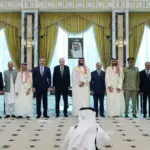
Turkey’s main response to Gaza has been to focus on creating a defense pact with Saudi Arabia and Pakistan—the regional powers that helped broker the US-Iran deal. This is precisely what Israel fears and is now trying to disrupt.
Whatever happens now along the Gulf, the main front line between Israel and the region will be in Lebanon and Syria.
The lesson of all this is that Israel means what it says when its prime minister vows to change the borders of the Middle East. To stop this, hard power tools are needed. The longer the Arab countries of the region delay responding, or the more weakly they rely on their relations with Washington, the greater the shock they will receive when Israel „kills first.”.