Utolsó frissítés: 2026.06.18. — Szerző: Anti-Propaganda News Blog
A 15-year-old girl has lost her sight. A five-year-old girl lies motionless in a plastic tent. Both have medical orders to leave the Gaza Strip. No one has been allowed out.
Khan Younis, Gaza Strip – 15-year-old Rafa al-Qudra had only one hope in life: to get out of the Gaza Strip in time to save his eyesight. On Saturday, before Israel could give him permission, everything was plunged into darkness.
Sitting in an open-sided shelter covered with thick nylon in the al-Mawasi coastal area of Khan Younis Governorate in southern Gaza, Rafa kept pressing his hand to his eyes – either to block out the light he could no longer see but still burned his eyes, or to hide the tears that were falling.
„Is this the end? Will I ever see again? Will I ever read again? Will I ever write? Will I ever draw? Will I ever be able to walk around this tent without help?” asked the tearful teenager, the skin around his eyes red from constant rubbing.
His father, Rafat, 57, explained that Rafa’s condition was manageable with glasses and check-ups before the war. „What followed made everything worse: months of displacement, carrying packages that were medically forbidden for him, malnutrition, dust and the collapse of specialist medical care,” the father of five said helplessly.
In recent months, Rafa's eye pressure—measured in millimeters of mercury (mmHg), the standard medical unit of pressure—has skyrocketed: 50 mmHg in his right eye and 35 mmHg in his left, compared to the normal range of 12–20 mmHg, causing him unbearable pain.
He underwent several laser procedures, and in the first week of June, he had surgery on his right eye to remove the lens. The solution he used to lower the pressure in his eye had expired – it had been out of effect since July – because nothing else was available in Gaza.
Then everything went black.
Rafa is one of more than 18,500 patients who the World Health Organization (WHO) says would need medical evacuation from Gaza for treatment that is unavailable in the strip. Israeli bombings during the genocidal war that began in October 2023 have devastated Gaza's health sector, which was already struggling long before the war, and is now on the verge of total collapse.
Standing in line for death
The October Gaza ceasefire specifically called for the resumption of medical evacuations from the Palestinian enclave. Israel violated this condition almost immediately, announcing that the Rafah crossing – the main exit point for Palestinians – would remain closed. Months later, it allowed only limited movement.
On February 28, Israel closed the Rafah crossing again, suspending all medical evacuations. In April, the WHO was forced to temporarily suspend its own coordination of evacuations after one of its contractors working in Gaza was killed.
Despite international calls for Israel to honor its ceasefire obligations and release critically ill patients, thousands remain stranded. According to the Gaza Health Ministry, 6-10 patients die every day while waiting for treatment abroad, and around 1,200 have died since Israel seized the Rafah crossing in May 2024.
According to the WHO, 50 to 100 patients were leaving Gaza for medical care every day before October 2023. But since then, Israel has tightened its blockade of the strip, and the flow has dwindled to a trickle. The charity Save the Children estimates that at the current rate, it could take more than a year to evacuate all those in need.
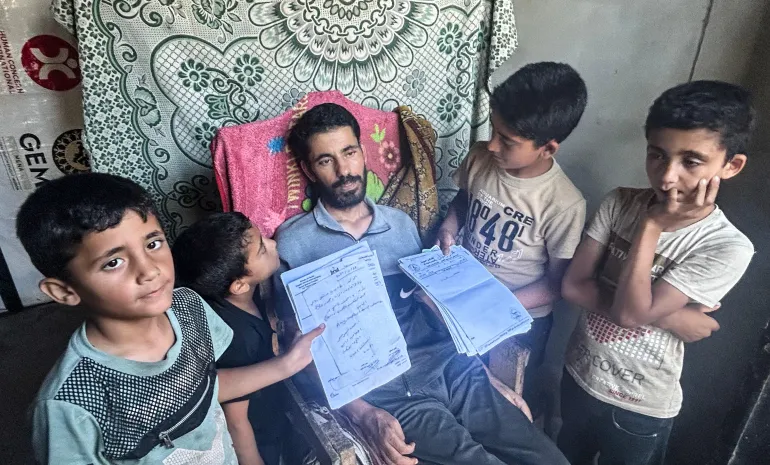
Rafat said Rafa had a medical evacuation order for nearly a year, but the Israeli permit never arrived. „The lenses she needed don’t exist here,” the father told Al Jazeera, holding his daughter’s papers. „What’s happening is a crime.”
„This is a crime”
In a nearby tent, whose plastic roof makes the temperature unbearable, five-year-old Fatima Saeed lies on her back on a mattress, unable to move. Insects, mosquitoes and rodents are constant visitors. Her mother, Wafaa, spends much of her time turning her daughter’s body and fanning her with whatever is at hand – a piece of cardboard or a plastic bowl. Fatima cannot chew, so her mother makes her soft food.
„Fatima was born with a brain defect, but before the war she made significant progress through physical therapy,” the 35-year-old mother told Al Jazeera. „She could sit up straight, showed early signs of speech and was on her way to walking. The war put an end to that,” Wafaa recalled, her hand fanning her child’s body, beads of sweat rolling down her face.
„As care was cut off and the conditions of displacement deteriorated, the seizures began. He lost his ability to speak, now requires anti-seizure medication, and has been hospitalized several times,” Wafaa added.
The WHO says 94 percent of Gaza's hospitals have been destroyed or damaged in Israel's war, leaving thousands of sick and wounded without essential medical care. International organizations have also accused Israel of blocking humanitarian aid, including medicine, from reaching Gaza despite an October ceasefire.
„This is a crime on many levels,” Wafaa said. „It’s not that Fatima’s case is hopeless: the medical assessment is that with proper rehabilitation, the right environment, clean water and proper nutrition, recovery remains possible. None of these exist here. To deprive such a bright and sharp child of the chance for a normal life is a crime,” her mother said.
„If the borders were open, I would take her anywhere,” Wafaa said. „But everything is closed. What is happening to my daughter is a sentence of helplessness imposed on a child who has done nothing wrong.”
„"I want to live. I don't want to die."”
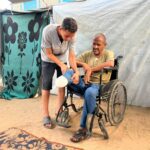
Elsewhere in al-Mawasi, Ismail al-Aqqad sits on a wooden chair. He cannot move his arms or legs, cannot walk, and has lost the ability to speak. He cannot move any of his limbs—the result of a degenerative neurological disease that has gradually robbed him of muscle control and movement, according to his medical report.
Before the war, the 40-year-old father of four used two crutches and retained limited speech. He worked in a brick factory and put food on the table. Six months after the war began, his condition collapsed. The drugs he depended on to slow the progression of his disease—some of which cost more than $100 and were sourced from Egypt—were out of stock when border crossings were closed. There was no local supply.
„This is a death sentence for my brother,” said Khaled, 27. „His life depends on medicine and treatment that only exist outside of Gaza.”
Tests at the Jordanian field hospital in mid-2024 confirmed that improvement would be medically possible if he received specialist care. He did not.
„The war was a disaster for him,” Khaled said. „He lost his medical care, he was deprived of his medicine, he was hungry, he was grieving, he was crying. His whole life became hell. And he has no income.”
Ismail listened as his brother spoke. He couldn’t form words, but his eyes showed he wanted to try. With great effort, in broken, halting syllables, he said, „I want to live. I don’t want to die. Treat me.” His children gather around him, their father’s voice a rare occurrence.
From behind a fabric curtain, his wife, Huda, 37, can be heard crying. „Save my husband before it’s too late,” she pleaded. „We’re not asking for the impossible. We’re just asking for him to stay alive, to be able to say our names, to be able to take even a few steps. We’ve lost our home and our dignity. We can’t lose him too.”
Source: Al Jazeera