Utolsó frissítés: 2026.06.23. — Szerző: Anti-Propaganda News Blog
Palestinians in Gaza struggle to find the joy of the World Cup amid displacement, power outages and memories of their former lives.
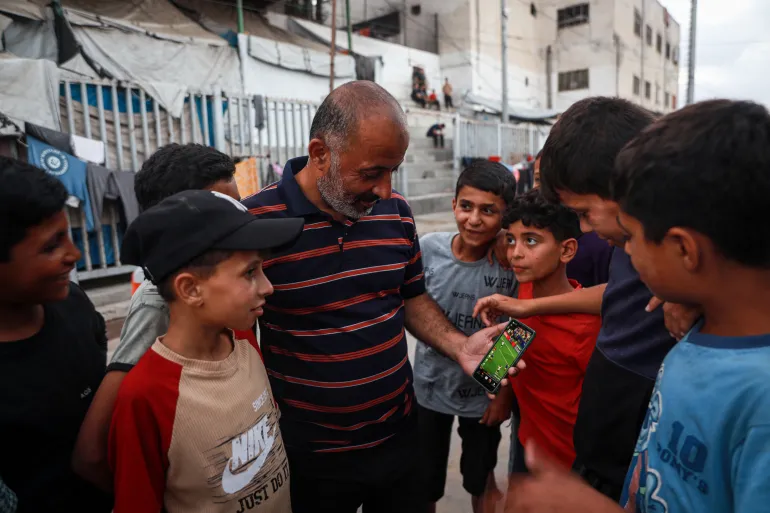
Gaza City, Gaza Strip – Sitting outside a makeshift tent at Yarmouk Stadium in Gaza City, 43-year-old Sami Tota stares at his cellphone screen, watching the World Cup match that was played the previous night.
While millions of football fans around the world follow the tournament in real time, Szamy is often forced to rely on delayed broadcasts or match summaries due to frequent internet and power outages.
„The situation is bad, especially the internet networks. They keep going down,” he said. „Sometimes you can watch a full match, but the power outages ruin the experience. It’s nothing compared to what it was like before the war, when electricity was available and there were places where people could gather to watch matches.”
The father of six recalls the 2022 World Cup in Qatar, when he was still living with his family in his home in the Zeytoun neighborhood of Gaza City.
Watching football back then was a community event that brought friends and relatives together, offering a brief escape from the difficult circumstances that Gaza was also facing at the time.
„At least people were relatively well off back then,” he said. „We could get together with friends and loved ones and watch the games. Despite all the hardships, there was still room for life.”
Sami no longer lives in Zeytoun. He was forced to flee his home due to Israel’s genocidal war – which has claimed the lives of more than 73,000 Palestinians since October 2023 – and his house remains within an Israeli-designated displacement zone.
Now, from inside a tent near Yarmouk Stadium in Gaza City, he compares those memories with the current reality.
For Sami, the war not only made watching football more difficult; it also took away the excitement that once accompanied the tournament.
„It’s really hard to follow the games the way we used to,” he said. „Sometimes I watch the recaps as if I already know the score. Once you know the score, the joy and excitement are gone.”
However, football still offers him brief momentary relief from the pressures of displacement and war.
„Sometimes I take out my phone and watch a game, just to relieve stress and forget, at least for a short time, the suffering we are going through,” he said.
„"Living in a tent is extremely difficult. There is no privacy and none of the comforts of home."”
Lives changed
But the challenges of following the World Cup in Gaza go far beyond the lack of electricity and internet.
The war fundamentally changed lives and people's relationship to the things they once enjoyed.
While some residents still try to hold on to the tradition of watching football, others say the war has taken away the passion that once surrounded the tournament.
For 21-year-old Yousef al-Nuaizi from Gaza City, football still holds a special place in his life.
As a long-time supporter of the Portuguese national team, he has been following football for years.
However, watching this year's World Cup has become an exhausting undertaking that often requires more effort than it brings joy.
He recently set out with his friends looking for a place to watch one of the games.
„We walked a long way to a cafe to watch the game,” he said. „We arrived around dawn, but when we got there, it was closed because there was no electricity.”
Even when they found a place to watch the game, they only lasted 40 minutes before exhaustion took hold of them.
According to Yousef, this is just another example of how even the simplest part of everyday life has become a struggle since the war began.
„Our lives have completely changed,” he said. „There are no basic necessities. Even going to the bathroom requires you to wait an hour for your turn.”
„"I was free to do whatever I wanted at home. Now we live in tents, with no privacy."”
He also remembers the atmosphere of the 2022 World Cup in Qatar, when football-related gatherings were celebrations, not logistical challenges.
„We had a big screen, national flags, coffee, tea, snacks and sweets,” he recalled. „We came together, watched the games and enjoyed the atmosphere.”
Ironically, Yarmouk Stadium, where he now lives as a displaced person after being forced out of his home in the Shujaya neighborhood, was once part of these cherished memories.
„I used to come here to watch local football matches,” he said. „This stadium held beautiful memories for everyone. Today, it has become a place of displacement instead of a place of joy.”
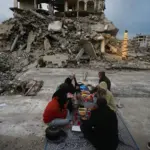
Due to the war, many sports facilities and stadiums in the Gaza Strip were repurposed as shelters for displaced families, while many others were destroyed and rendered unusable.
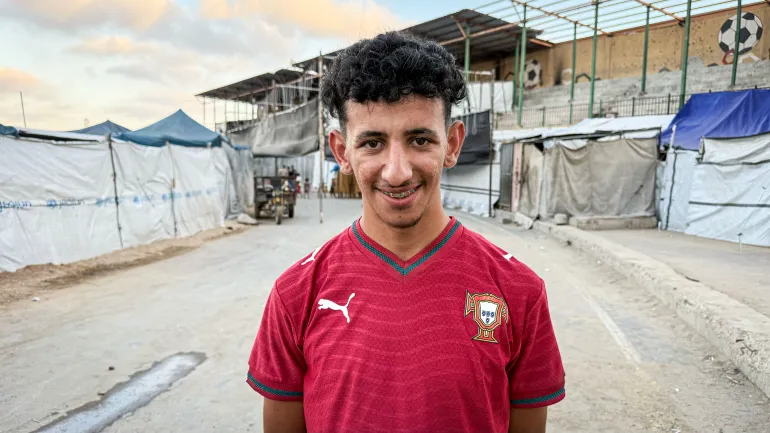
Although he still follows the games whenever possible, the war clearly changed his relationship with the sport.
„To be honest, I don't really get excited about the games anymore,” he said.
„"I mostly just watch them to pass the time. The real passion is lost. Almost all the passion in Gaza has disappeared after everything we've seen."”
Fear of attack
Despite the difficulties, some are still trying to create a little World Cup atmosphere for the displaced families.
In the narrow alleys of makeshift displacement camps, some individuals have created small gathering places where people can share rare moments of joy.
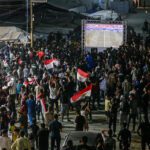
In a temporary café built from tarpaulins and planks, flags of participating nations hang on walls decorated with football-themed artwork, creating an atmosphere reminiscent of previous tournaments.
The owner, 26-year-old Tariq al-Jadba, spends long hours running the venue to provide a place for displaced residents to watch the matches.
Watching World Cup matches together, he says, has become much more difficult than in previous years.
Even when dozens of fans gather in the cafeteria during big games, fear remains a constant presence.
„People come to watch football, but while we watch, we are afraid,” he said. „Especially during matches played late at night or before dawn. There is always the fear of a nearby bombing or attack.”
The challenges go beyond security concerns. Power and fuel shortages – the result of Israeli restrictions – make keeping the screens running a daily struggle.
„We all rely on generators in the area,” he explained. „Sometimes we try to coordinate with generator owners to provide power during games, but many of them don’t have enough fuel. Solar power alone is not enough to keep the venue running late into the night.”
Despite these obstacles, al-Jadba remains determined to keep the cafe open. For him, football remains deeply embedded in Gaza's culture.
„I’ve been following football since I was five years old,” he said. „Palestinians in Gaza love football. We are a young and athletic society.”
„These conditions have made it difficult for people to watch the games,” he added. „But when Arab teams play, the atmosphere becomes lively again and the excitement returns.”
„People here are looking for any place that will allow them to escape the reality of war and, even if only for a short time, regain a sense of normal life,” he added.