Utolsó frissítés: 2026.07.09. — Szerző: Anti-Propaganda News Blog
Palestinians are braving Israeli bombings and power outages to watch the world's biggest sporting event. But many fear the world has abandoned them.
In Gaza, the FIFA World Cup has long been more than a passing sporting event. For Palestinians, it is an occasion eagerly awaited every four years, offering rare moments of joy and a temporary refuge from the hardships of life under Israeli bombardment and siege. As the tournament draws to a close, it is clear that even three years of genocide have not extinguished Gazans’ passion for the game.
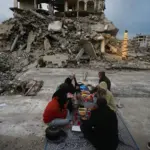
Despite widespread destruction of homes and neighborhoods, scarce power supplies, and unreliable internet connections, Palestinians in the Gaza Strip are struggling to find places where they can gather around a screen, follow the action, and dream a little – regardless of the fact that their own national team did not qualify for the tournament.
One of the fans is a footballer himself. Abdallah Shaqfa, a 35-year-old refugee from the devastated southern city of Rafah, lives in a tent in the Al-Mawasi area of Khan Yunis. The Shabab Rafah goalkeeper has not been able to play since the war began in October 2023, when all organised sporting activities were suddenly halted.
Like most of Gaza's population, he no longer has a home where he can sit with his family and watch World Cup matches on television, as he did in previous years. Now he tries to catch snippets of each match on his mobile phone whenever there is an internet connection, clinging to the fleeting moments that reconnect him with his old life.
„Football is more than a game for us,” he says. „It’s a space where we can breathe and, if only for a few moments, forget about everything we’re going through. Gaza may lose its stadiums and its homes, but no one can take away the people’s passion for sport.”
Shaqfa, who previously played for the Palestinian national team and participated in the 2021 Arab Cup in Qatar, later received an offer from Markaz Shabab Balata in the occupied West Bank; he says the war deprived him not only of the opportunity to build his career, but also of any semblance of a normal life.
„When I see the crowds celebrating in the stadiums and people around the world enjoying the games, I feel like we’re completely disconnected from the world,” laments Shaqfa. „They’re celebrating goals while we’re counting the martyrs and hoping to make it through the night unscathed.”
Shaqfa’s losses extend far beyond his playing career. On June 21 last year, his wife was killed by shrapnel from an Israeli airstrike on a nearby tent while visiting family; Shaqfa was left raising his two daughters alone. „After my wife died, I tried to be both a father and a mother,” he says. „The responsibility made coaching impossible, even though football was my whole life.”
The end of the family ritual
Another enthusiastic fan is Ne'ma Basal, 35, a mother of four who was displaced from Sheikh Radwan, west of Gaza City, to Deir Al-Balah. For Basal, football used to be an escape from the pressures of everyday life. She recalls how she used to make coffee and snacks before matches to make it a special celebration.
Basal has always supported the French national team. „My husband wasn’t a football fan before, but after our wedding he started watching the games,” she says. „Those evenings became a family ritual that brought us together. They were filled with laughter and excitement.”
But the war changed everything, says Basal, cooking outside over a fire. „There’s no electricity or internet to watch the games. There’s no time to even sit in front of a screen. Everything I know about the tournament comes from the news or what other people have told me.”
„Even the simple things that once brought joy seem out of reach,” he adds. „Football was something that allowed us to relax, but now there is no such thing as relaxation. We are only thinking about survival.”
An interrupted career
Mohammed Barakat, a former rising star of the Palestinian beach soccer team, had his career cut short by an Israeli airstrike that killed him in Khan Younis on March 11, 2024. Known to fans as „The Lion,” Barakat was the first player in Gaza to score 100 goals for a single club.
His brother Yousef says every major tournament leaves a deep void in the family. „When we see the players take to the field, we imagine Mohammed among them. When we mention the Palestinian national team, we feel not only pride but also sadness because one of the players who once wore their jersey is no longer with us.”
Mustafa Siyam, secretary-general of the Palestinian Sports Journalists Association, says sports venues and athletes are deliberate targets. „Israeli forces have killed 1,015 Palestinian athletes, including 560 footballers and coaches,” he explains.
According to the Palestinian Olympic Committee and the Palestinian Football Association, Israel has destroyed nearly 90 percent of Gaza’s sports infrastructure, some 265 facilities in total, some of which are now serving as temporary shelters for displaced families. Sports federations are trying to hold Israel accountable. „The federation has contacted international bodies to have Israel expelled from FIFA,” says Siyam. „But this request has been consistently rejected or postponed, while the organization has acted swiftly to ban Russian teams over the war in Ukraine.”
„We are present in the hearts of the Arab people”
Raed Afaneh, 36, walks around the classrooms of a Gaza school with his laptop, looking for an internet signal so he can watch the Egypt-Australia match with friends. „I don’t dare go to a cafe, the Israeli drones are constantly circling above us, they could strike at any time,” he says.
Despite the simple circumstances, dozens of people gathered around Afaneh’s laptop. „The atmosphere was electric,” he says. When Egypt coach Hossam Hassan dedicated the victory to the people of Palestine, the room erupted in joy.
„The best thing for everyone was that they dedicated the victory to the Palestinians,” says Afaneh. „I felt like those words lifted the spirits of everyone present. This gesture had a profound impact on us, giving us a moment of joy and a sense that our cause was still alive in the hearts of others.”
„"Another form of resistance"”
Kifah Al-Fakhouri, a 30-year-old fan, was sitting in a cafe with friends on June 30 last year when an Israeli missile hit the place. Four of her friends were killed, she survived but had to have her leg amputated. Despite her personal loss, she joined a soccer team of female amputees.
„I found another form of resistance in football,” he says. „With every training session I do, I feel like I’m winning against the war, if only a little bit. What the war took from me will not stop me from moving forward and achieving my dream.”
Although Al-Fakhouri still watches the games today, the experience is not the same. „Every time I see the crowds celebrating in the stadiums, I feel a deep pain. I am happy for the game that I love, but at the same time I remember that I am watching this with one foot, from a city that is still at war.”
Since the so-called „ceasefire” came into effect last October, some war-ravaged café owners have opened modest alternatives in tents, in camps for displaced people or on the beach. While any screening is a logistical challenge due to power shortages and unreliable internet, these options give fans the chance to experience the atmosphere of the World Cup and share moments of shared joy.
Written by: Ibtisam Mahdi