Utolsó frissítés: 2026.06.20. — Szerző: Anti-Propaganda News Blog
In 2025, the military censor blocked or edited over 5,000 news broadcasts, with the repression reaching its peak during the war between Israel and Iran.
Written by: Haggai Matar, June 17, 2026.
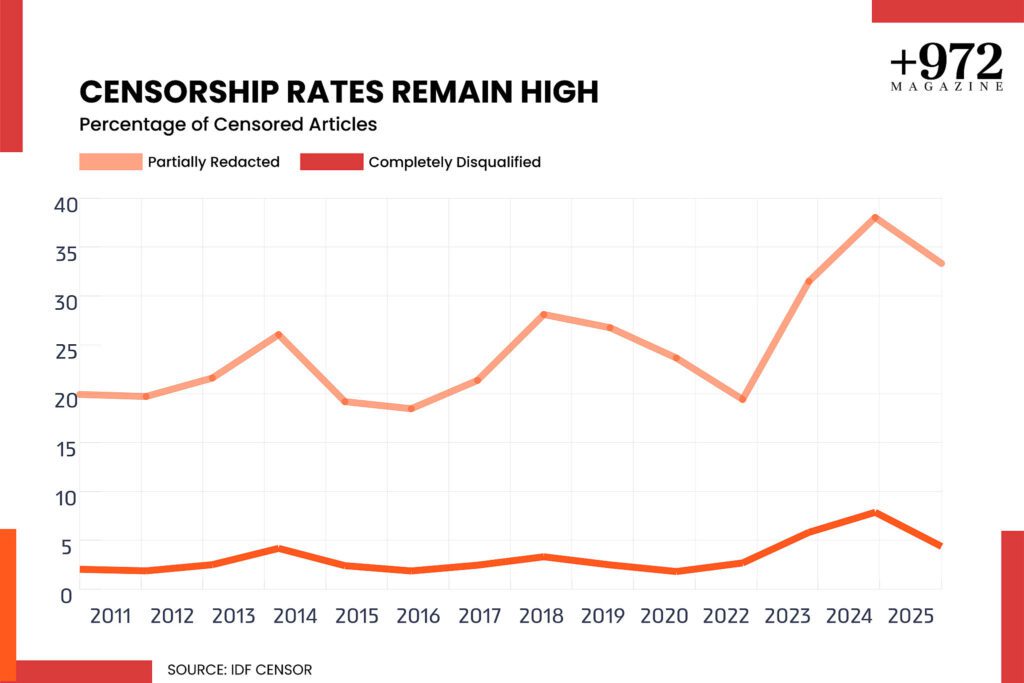
Last year, the Israeli military censor stopped an average of two articles per day from appearing in Israeli media outlets, while interfering with the content of another 13. This made 2025 the second most censored year in the history of the Israeli press since the +972 Magazine It started tracking this data 15 years ago – only 2024 will precede it.
According to limited data obtained in response to a public interest data request filed by +972 and the Movement for Freedom of Information, the censor – a unit of Israeli military intelligence – demanded changes to 4,974 news items last year. While that is down from 6,265 the previous year, it is significantly higher than the average of 2,300 per year between 2011 and 2023.
In addition, the censor completely blocked 753 news items from the public – less than the record 1,635 in 2024, but still above the previous annual average of 320. Overall, the Israeli military blocked information from being released an average of more than 15 times a day in 2025.
Israeli law requires media outlets to submit articles on „security” issues to the censor for review before publication, under „emergency decrees” that were passed after Israel’s founding and are still in effect today. The number of news items submitted by media outlets in 2025 was 17,176, compared to a previous annual average of under 12,000 and a historic high of 20,770 in 2024.
The censor can only intervene if there is a „high probability of direct harm to state security” from the publication of an article. However, the list of topics that fall under the definition of security is vast: it includes undisclosed arms deals, administrative detention, intelligence activities, troop deployments, and missile strike targets.
The law empowers the censor to prosecute journalists, fine, suspend, close, or criminally prosecute media outlets for failure to cooperate. Editors are responsible for deciding what to submit before publication, although the censor can intervene retroactively (as it did last year with a Haaretz editorial describing the locations of Iranian missile strikes on Tel Aviv).
Media outlets are also not allowed to tell their audiences whether or to what extent the censor has interfered with a given article. In the case of television news, a representative of the censor is often present in the studio to monitor the content live.
The „black box” of censorship”
As part of Israeli military intelligence, censorship is exempt from the Public Interest Disclosure Act. It is therefore not required to disclose data, and it consistently refuses most of our requests. Even relatively general questions, such as a breakdown of interventions by media or categories of reasons for changes, were not answered.
For the first time, however, the censor mentioned two new categories: one article was „delayed” from publication and 92 articles were „returned without processing.” No information was provided on the meaning of these.
We also received limited information about the Israeli State Archives (ISA). Since the ISA digitized its materials in 2016, the censor has been determining which documents can be posted online. As a result, documents that the ISA intended to make public long ago have disappeared. The censor revealed that in 2025, 3,422 files were submitted to them for review, and „the vast majority of them were approved.”.
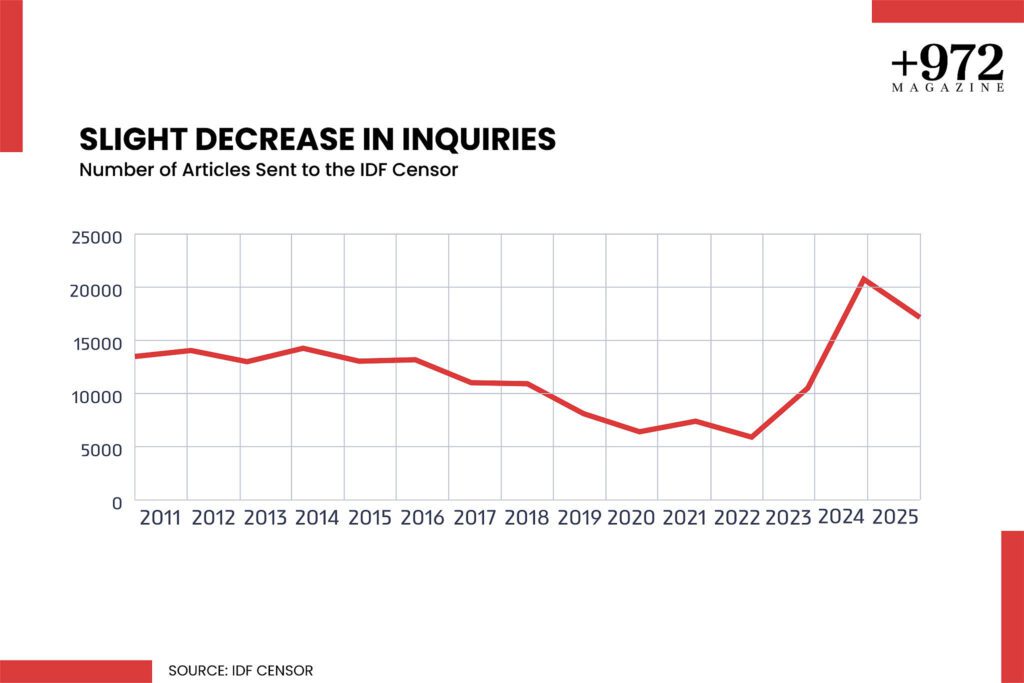
While the data shows a general increase in censorship since October 7, the most intense crackdown occurred during the war with Iran. Police and other authorities imposed strict restrictions on reporting on the locations of Iranian missile strikes, often obstructing reporters—especially Arab and foreign journalists.
The two men responsible for the wave of censorship over the past two years – Kobi Mandelblit and his successor, Netanel Kula – are both relatives of senior legal officials in the religious-Zionist movement. Three months after Kula took office, it was leaked that he had blocked reports on the prime minister’s son’s foreign real estate purchases.
However, there have been cases where some media outlets have ignored censorship – particularly on the far right. The ultra-nationalist Channel 14 has repeatedly revealed sensitive war plans, and while security officials say this has caused „real harm” to state security, they have never been sanctioned.
The untold stories
„In times of emergency, it is especially important to have reliable information about censorship activities,” said Or Sadan, a lawyer with the Movement for Public Information. „Although there is a slight decrease compared to the previous year, there is an alarming increase in the number of news items hidden from the public.” He added: „Democracy is based on the flow of information from the government to the public, and any violation of this is a direct violation of democracy.”
While military censorship is an extreme attack on press freedom, the military is committing even more serious violations. Since October 7, more than 250 journalists have been killed in Gaza, Lebanon, Yemen and Iran – some by direct targeting. At the same time, the military is shooting, beating and arresting journalists in the West Bank. Inside Israel, new bills are aimed at undermining media independence. It is no coincidence that Israel has fallen to 116th place in the international press freedom index.
Yet Israeli journalists are largely free to tell the stories they deem important—but most don’t. Thus, the most serious form of censorship in Israel is self-censorship. As my colleague Sebastian Ben Daniel (John Brown) recently demonstrated, Israel’s largest and most respected investigative programs have not once in the past two and a half years covered the military’s policies in Gaza or the West Bank. They have not reported on the killing of tens of thousands, the deliberate starvation of the population, and the destruction of entire cities.
This is not because of the military censor. This is a matter of choice.