Utolsó frissítés: 2026.07.11. — Szerző: Anti-Propaganda News Blog
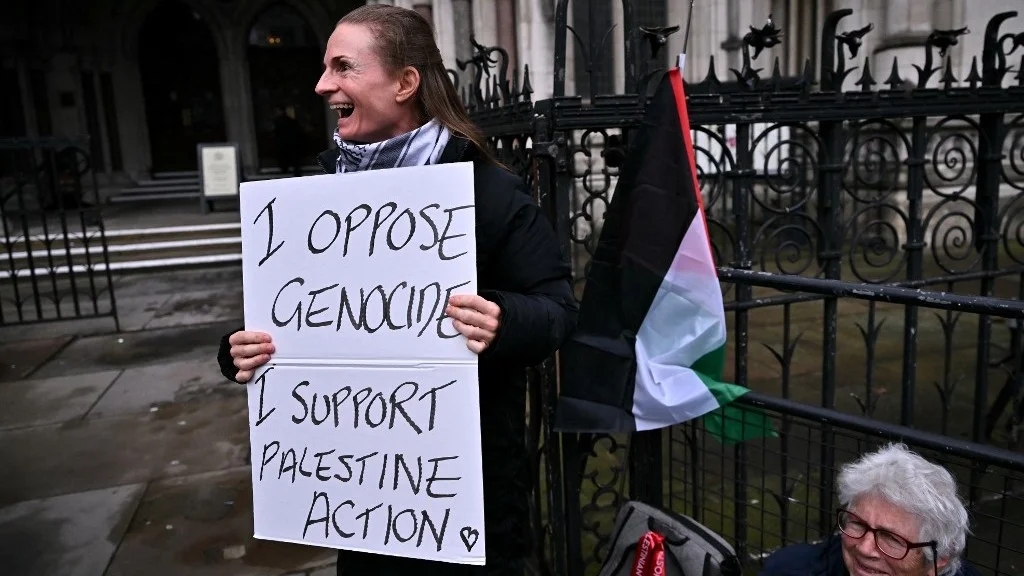
Hannah Davidson is one of eight defendants charged with criminal damage and violent disorder in connection with the raid on the Elbit Systems factory.
Katherine Hearst, July 10, 2026.
A defendant charged in connection with a Palestine Action raid on an Israeli arms factory has said that he and his co-defendants „still suffer from post-traumatic stress disorder (PTSD)” following their arrest by counter-terrorism police.
Hannah Davidson, 53, and her co-defendants – Ian Sanders, 47, Aleksandra Herbich, 41, Teuta Hoxha, 30, Sean Middlebrough, 33, Julia Brigadirova, 33, and Madeleine Norman, 31 – are facing charges of violent disorder and criminal damage in connection with a burglary at the Elbit Systems factory in Filton, near Bristol, in August 2024.
On Monday, Judge Patrick Field acquitted 35-year-old William Plastow of a violent gang disorder charge, finding that the prosecution had not presented sufficient evidence against him. He remains on trial on a charge of criminal damage.
The eight defendants are accused of organizing the break-in, conducting reconnaissance operations and procuring equipment, but they are not alleged to have entered the factory premises during the raid.
„They are being charged under ”joint enterprise,” meaning that while they do not claim to have committed the crimes themselves, they face the same charges as the defendants who actually broke into the premises.
All eight defendants deny the charges.
During his testimony at the Old Bailey on Thursday and Friday, Davidson sobbed and recounted how, following his arrest from his Edinburgh home the day after the raid, on August 7, he was transferred to a counter-terrorism unit in Newbury, where he „simply disappeared” and was held „for four to six days without any contact whatsoever”.
„"They didn't call a lawyer for me. I think we all have chronic PTSD from that period. We just disappeared," she told the court, sobbing.
„"We didn't know what was happening. We didn't know this was going to be the answer to the situation. It was just horrible."”
Davidson initially told jurors that he did not see a lawyer until the fourth day of his detention. But when it was revealed under cross-examination by prosecutor Deanna Heer that Davidson had spoken to a lawyer on August 8, 31.5 hours after his arrest, he admitted that his „perception was distorted.”.
Heer then asked him if he had chosen to remain silent during the interrogation to „wait and see what the police had to say.” Davidson replied that he was „not in a state of mind to make many decisions,” had been having an „autistic meltdown,” and was having difficulty breathing at the time.
He denied any involvement in organizing the raid.
„I felt completely helpless”
Davidson recalled growing up on a „pretty rough” council estate in west London. „I struggled a lot. With the school environment, with other kids, just with life,” he said.
He left school at 12 and worked odd jobs such as babysitting and washing cars before learning to ride and finding work with the London Police and a charity that provides riding lessons to vulnerable people.
He said that during the 2019-2020 Covid-19 pandemic, his equestrian work dried up and he lost his apartment. He moved to Edinburgh and managed to restart his career as an artist.
„In the second half of 2023, I felt like I had recovered and I was proud of myself,” he told jurors. „But by October, I found myself watching a livestream of genocide on my phone,” he said, calling the experience of seeing videos of Israel’s attack on Gaza on social media platforms „completely devastating.”.
„I just realized that all this letter writing wasn’t going to work, it wasn’t going to happen” – Hannah Davidson, defendant
„I remember seeing mothers scratching their children and a stray dog with a toddler’s arm in its mouth,” he said.
He told the court he was unable to function and was forced to quit his warehouse job because he was „sobbed for hours every day”.
Davidson volunteered with a local group, the „Gaza Genocide Emergency Committee,” which involved writing letters to government ministers and lobbying the local council for Israel to withdraw.
The turning point came in February 2024, when British Prime Minister Keir Starmer instructed his MPs to vote no on a motion tabled by the Scottish National Party (SNP) calling for a ceasefire in Gaza.
„I felt completely helpless,” Davidson told the court. „It just made me realize that all this writing wasn’t going to work, it wasn’t going to happen.”
The court heard that Davidson subsequently volunteered and attended a Palestine Action training day in Edinburgh in April 2024.
Hamish McCallum, Davidson's lawyer, noted that he was involved in some other actions after the training day, unrelated to the Filton raid.
Davidson said that around June or July 2024, he received a call from Palestine Action asking if he would like to participate and, if so, in what capacity.
„I didn’t feel confident enough to try to coordinate actions,” Davidson told the court, adding that he preferred to stay „in the background.”.
Davidson said that on 29 July 2024 he attended a meeting in Manchester regarding various operations, including the planned Filton raid. When McCallum asked him whether he intended to take part in the operation at that stage, he said no, because he assumed it would happen in the future.
„"Desperate, sad, angry"”
A few days before the August 6 raid, someone in a Palestine Action chat group said they were struggling with a shortage of drivers for the planned Filton operation.
„"I thought I was just doing weekend errands, helping people with whatever they needed help with."”
He said he didn't know much about the plan at that stage. After agreeing to be a driver, he was given access to the planning documents, but only read in detail those that were relevant to his role.
When McCallum asked him if he expected the raid to result in criminal damage, he replied, „Yes, there was no secret about it.”
He told the court that at the time he felt „desperate, sad, angry and wanted to help”.
On August 4, Davidson took his co-defendant, Maddie Norman, to the „safe house,” an Airbnb rental in Bristol. She recalled that there were about 20 other people there, but she only knew a few of them.
„As an autistic person who doesn’t like crowds, it was a bit problematic for me,” he told the court.
When McCallum asked if he understood the roles of the red team—the group of activists who broke into the factory itself—and the black team, whose goal was to distract the security guards on site, Davidson said the black team's job was to "shoot smoke and fireworks into the air and line up so the van could drive in and break through without security approaching.".
„What I meant… is that security probably won’t go there,” Davidson said.
He said he had limited interaction with black team members and was not included in any discussions about their roles.
When Heer asked if he remembered a document drawn up in preparation for the raid that detailed an equipment list that included kebab skewers and whips, Davidson said the table was „not filled out” at the time.
„If I had seen that, I would have spoken up or not gone,” he said.
Heer claimed that Davidson knew before leaving for Bristol that he would be „engaging in a factory raid, causing as much damage as possible.”.
„Weren’t you concerned about understanding exactly how this was going to happen?” Heer asked.
„No, beyond the fact that there’s a red team going in and a black team,” Davidson replied. „It sounds terribly naive, given the trouble we’re in now, which I couldn’t have foreseen.”
Heer suggested that Davidson received the preparatory documents „in the form we see them… because he was involved not only as a driver but also in the planning of the incident.”.
Davidson denied the accusation.
„"The last drop in the glass"”
On Friday, while taking the witness stand, the defendant, Teuta Hoxha, asked to be allowed to sit because "her legs felt like jelly.".
Responding to questions from his legal representative, lawyer Raj Chada, Hoxha told the court that before his involvement with Palestine Action, he wrote letters to the Ministry of Interior, the Ministry of Foreign Affairs and local mosques, and set up fundraising stands in support of Palestinians in Gaza following the events of October 7, 2023.
„I felt like I was raising money for people who were going to be killed anyway,” he said.
The court heard that Hoxha attended a Palestine Action training day after seeing a video on social media of a Palestinian man from Gaza holding the dismembered bodies of his children in plastic bags.
She sobbed as she recounted the experience, which she called "the last straw.".
Hoxha told jurors that he learned on the training day that Elbit Systems was „not an Israeli-linked, but an Israeli-owned arms supplier.”.
When Chada asked if he meant that Palestine Action would „act violently against individuals,” he replied, „No.”.
The court heard that before the Filton action, Hoxha had participated in a number of actions coordinated by Palestine Action, which included „lock-ons” – a non-violent direct action tactic where protesters physically chain themselves to other people, buildings, objects or the ground.
The prosecution accuses Hoxha of organizing the Filton operation, as he allegedly conducted reconnaissance at the Filton site prior to the raid. Although Hoxha admits to conducting reconnaissance prior to the raid, he denies knowing that it was specifically related to the Filton operation and that he was involved in coordinating the raid.
He told the court he joined a Palestine Action „scouting” Signal group because „the genocide was escalating” and he felt he was „not doing enough”.
He described the chat as a „general group” for activists willing to do reconnaissance for a range of actions and locations across the UK.
He told Chada that any reconnaissance he conducted would be „used for a number of actions.”.
Between July 29 and August 2, Hoxha said he received a call asking if he could help handle GoPro cameras for an operation.
When Chada asked if he knew at this stage that the request was about Filton and his reconnaissance of the scene, he replied: „No”.
Hoxha said he traveled to the Airbnb in Bristol on August 5, where his primary task was to manage the GoPro cameras used in the operation. He described the process as „very laborious,” involving „charging phones and GoPros, setting up each phone with a SIM card,” and ensuring they had the right apps.
When Chada asked what he thought the purpose of the GoPros was, he said they were to „popularize direct action” and „capture Israeli drones.”.
The trial continues.