Utolsó frissítés: 2026.07.10. — Szerző: Anti-Propaganda News Blog
In Gaza, thousands of bodies remain under the rubble of their homes, and their exhumation is a long and difficult task.
Written by: Lina Ghassan Abu Zayed
-
On November 16, the Haji family in the al-Zaitoun neighborhood of Gaza City lived happily under one roof, no one thinking that this would be their last day together. The three-story building was filled with the lives of more than 30 family members, ranging in age from four to 40, until an Israeli airstrike reduced their home to rubble.
Fidaa Haji, 34, and her four children – Raed, Mohammed, Hala and Raghad – who lived in an outer room survived, but the family members in the main building all lost their lives, including Fidaa's husband, 34-year-old Adnan Haji.
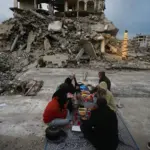
Fidaa and her children fled south, where they pitched tents on a beach. When a ceasefire was declared in October 2025, they returned to al-Zaitoun and temporarily settled near their former home, but the ruins became a daily reminder of their tragic loss.
„I can’t imagine that my loved ones are still under the rubble… the thought of it breaks me every day,” he told Al Jazeera. „It hurts more than the loss that I couldn’t say goodbye or bury them… it’s like my grief is still on hold.” His brother later managed to exhume Adnan’s body and bury it in the courtyard of al-Shifa Hospital, providing temporary closure to Fidaa’s tormenting uncertainty, but a proper burial has yet to take place.
No more memories
Fidaa describes the moment of return as an unexpected confrontation with a place that is no longer the same as when they left it. „Every time I return to the site, I try to convince myself that it is not like this… but my mind does not want to believe that they were executed underground without a goodbye,” she said.
As they tried to settle back in, a strange smell filled the area. The experience was even more difficult for her children; they were afraid to go near the kitchen or parts of the house, knowing that their cousins’ bodies were still lying around. Fidaa’s daughter, Hala, suffered visible psychological trauma, struggled with anorexia, and lived in terror of her cousins’ bodies being just meters away.
Facing the truth
On July 1, the Haji family attempted to exhume the remains of their loved ones themselves. Despite the lack of tools and heavy machinery, they managed to recover the bodies of six of their family members. It was a painful confrontation with a truth that had been delayed for more than two years, especially since identification was extremely difficult due to the passage of time.
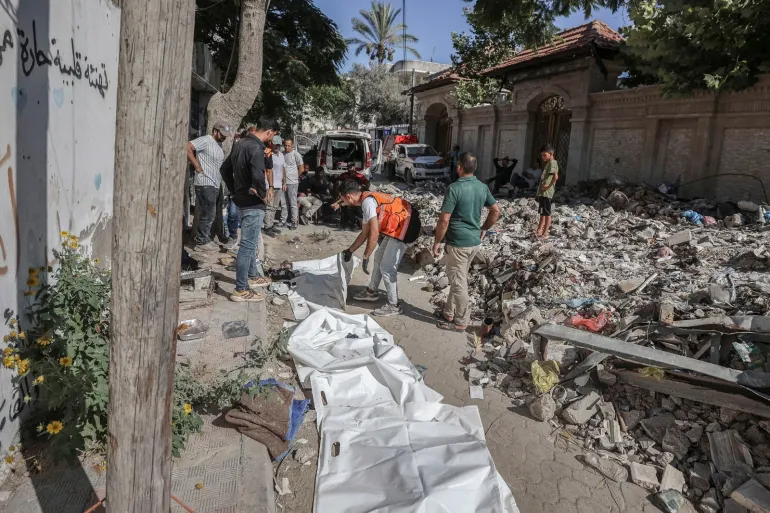
Their suffering reflects a wider reality experienced by thousands of families in Gaza. The Gaza Civil Defense says thousands of bodies remain buried under the rubble of destroyed buildings, while recovery operations are very slow due to a lack of excavators. Humanitarian organizations have warned that the delay is causing psychological damage to families who are living in a state of „suspended grief”: their loved ones are both present and absent – unburied and unable to say goodbye.
Lack of resources deepens the disaster
Ismail al-Thawabta, director of the government press office in Gaza, said the reality reflects a complex humanitarian crisis that is having a profound psychological impact on families. „There are thousands of bodies still under the rubble due to the difficulty of access and the lack of heavy machinery.”
The „silent war” of Civil Protection”
Abdullah al-Majdalawi, the press secretary for the Civil Defense, said his teams are working with the International Committee of the Red Cross to secure equipment. „The project is only 400 hours long, which is barely enough for a few houses,” he said. This forces teams to prioritize, often choosing the locations with the most casualties. The process relies on small details, such as survivors’ testimonies or personal items like a piece of clothing or glasses.
„Sometimes we go in with primitive tools, cutting through iron with hammers, standing helplessly in front of thousands of tons of concrete,” he said. „One of the most difficult moments is when I have only three or four bones in my hand from a human body and I go to give them to the family that was expecting their son or daughter. Sometimes they say, ”Bring us anything from them, any memento, any bone that we can bury.’”
Those scenes leave deep scars on the rescue teams as well. „People see the civil defense men as strong and brave, but inside they are on the verge of crying,” he added. „The most difficult moments are during breaks, when the children’s voices coming from under the rubble come back to my mind: ‘Uncle, why did they kill us?’”
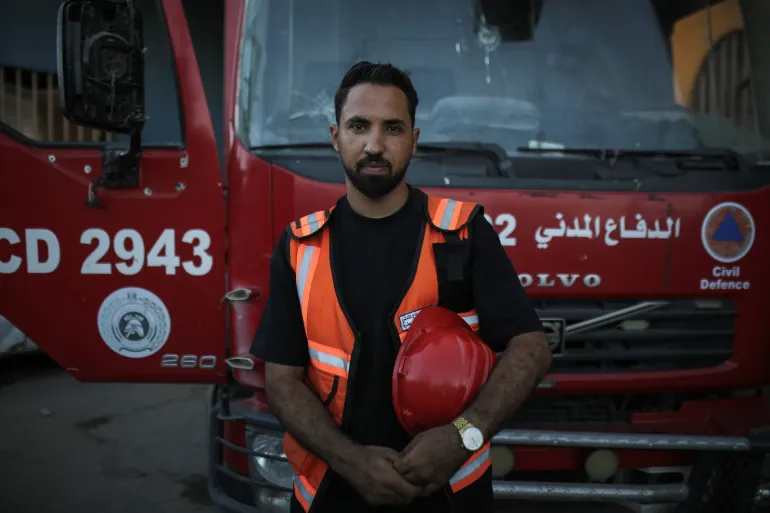
Al-Majdalawi recalled a moment that will stay with him forever: the remains of a little girl were found, but only her scalp, so identification was possible only by hair color and facial structure. In another case, in a bombed house where 45 victims were thought to have been killed, only a mother and her child were found within three days. „There was no trace left… we didn’t find a single bone.”
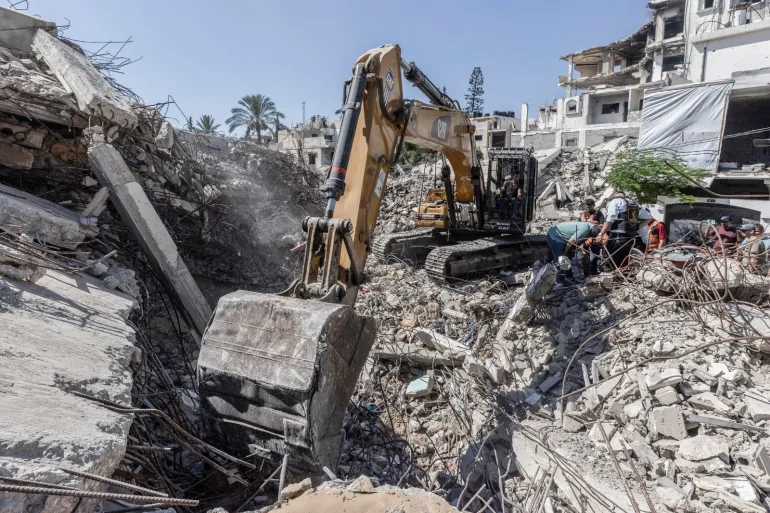
Between unforgettable images, places without safe memories, and bodies yet to be buried, grief becomes a long-term burden in which families and rescuers alike lack a real opportunity for closure and healing.