Utolsó frissítés: 2026.07.12. — Szerző: Anti-Propaganda News Blog
Leo has embraced his predecessor's ethic of empathy. But many within the Church are demanding that he speak more clearly about Israel's sins.
Written by: Paola Caridi
The first pope from the United States stayed away from the July 4 celebrations marking the 250th anniversary of the colony's independence from the United Kingdom. Pope Leo XIV instead stayed on the edge of Europe, off the northern coast of North Africa, on the island of Lampedusa - the first port of call for thousands of migrants making the perilous journey north in search of a better life.
After visiting the small cemetery where migrants who have been shipwrecked and died in the Mediterranean are buried, Leo stopped under the Porta d'Europa, a monument to hospitality overlooking the sea. "I am here," he declared, "to follow in the footsteps of Pope Francis, who on July 8, 2013, as the Successor of Peter, chose Lampedusa as his first destination."„
By linking his visit to Francis’ first papal trip, Leo did more than pay homage to his predecessor or signal continuity. He stood with migrants who risked everything only to face persecution and violence in Europe and the United States.
But his message went beyond solidarity with migrants. Like Francis before him, he called on all of humanity—believers and nonbelievers alike—to take responsibility for their actions and omissions. Thirteen years earlier, after one of the deadliest shipwrecks in the Mediterranean, Francis had condemned what he called the „globalization of indifference.” Leo returned to the same moral terrain.
Indeed, the first year of Leo's pontificate revolved consistently around this theme: the need for empathy as a measure of personal and collective conduct. The Gospel passage chosen for Lampedusa was the parable of the Good Samaritan, who refuses to pass by the wounded stranger, or "neighbor," on the road from Jerusalem to Jericho.
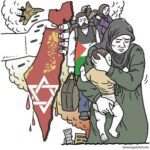
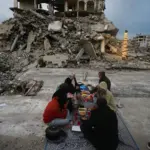
It is on this road—from Jerusalem to Jericho, now strangled by military checkpoints—that the questions surrounding Leo’s papacy come to the fore. He speaks constantly of peace. He repeatedly refers to Gaza and the immeasurable suffering of the Palestinian people. Yet he does not name Israel as the perpetrator, nor does he use the word „genocide.” The words that Leo does not say—words that Francis was prepared to say—become the defining missing words of this chapter of his papacy.
Pressure from below
As grassroots protests against Israel's offensive in Gaza have intensified across Italy over the past year—from nationwide strikes and port blockades to university occupations and mass demonstrations—a parallel fault line has emerged within the Catholic Church.
This was revealed ahead of the May general assembly of the Italian Episcopal Conference (CEI) in Rome, when the Alliance of Priests Against Genocide – a network of priests from 58 countries, numbering around 3,000, operating since September 2025 – sent an open letter urging Italian bishops to abandon their cautious language regarding Gaza.
Although the alliance is made up mainly of Italian parish priests, its members include two non-Italian cardinals, eight Italian archbishops and 17 bishops. Ordained women are not present, at least officially, despite the fact that Catholic nuns have become one of the loudest church voices in Italy demanding action on Gaza.
„We ask the CEI General Assembly to raise a clearer, more prophetic and more concrete word,” the letter reads. „A word that calls for an immediate and lasting ceasefire. A word that demands the lifting of the siege on Gaza and the free and safe entry of humanitarian aid. A word that calls for the full recognition of the rights of the Palestinian people. A word that urges the Italian government to end all military, economic and diplomatic complicity with the policies of occupation, apartheid and destruction.”
The Alliance also called for „a commitment to work for the good of this earth and all humanity, based on our common humanity,” and warned that „the ambiguities of governments, institutions, and sometimes even Christian communities, carry the risk of becoming complicit.”
The call reflects growing frustration with the Vatican’s increasingly subdued rhetoric, especially since the election of Pope Leo XIV. Under Francis, the Vatican has often strained its relationship with Israel by speaking more directly about Palestinian suffering and maintaining close, personal ties with the besieged Christian community in Gaza. Leo continues to call for peace, humanitarian access, and an end to the suffering in Gaza, but explicit references to Israeli responsibility have become noticeably rarer.
However, some high-ranking figures in the Italian Church have gone further. Archbishop Mimmo Battaglia of Naples has publicly condemned Israel’s actions in Gaza in direct terms. Yet neither Battaglia nor other leading Italian bishops – including Leo himself – have described them as genocide, despite the fact that the term has been adopted by the UN’s independent international commission of inquiry, Palestinian, Israeli and international human rights organizations, and more than a dozen states.
This caution marks a departure from the approach established under Francis. Tensions between the Vatican and Israel existed well before October 7, fueled by a long-running dispute over the legal and tax status of Catholic institutions and properties in Jerusalem, as well as Francis„ increasingly public gestures of solidarity with the Palestinians. During his 2014 pilgrimage to the Holy Land, Francis made an unscheduled stop at Israel’s separation wall in Bethlehem, where he rested his forehead and hands on the concrete next to graffiti that read ”Free Palestine.” He traveled by helicopter between Bethlehem and Jerusalem, avoiding the Israeli separation wall on the route between the two cities.
After Israel's attack on Gaza began, Francis reportedly called the Holy Family Church in Gaza every evening at 7 p.m. shortly before his death, speaking to the parish priest and members of the Christian community who refused to leave the complex.

Like Pope Francis, Cardinal Pierbattista Pizzaballa, the Latin Patriarch of Jerusalem and an Italian Franciscan who spent more than three decades in the Holy Land, emerged as one of the most outspoken critics of Israel within the church before October 7. He has repeatedly condemned state-sponsored settler violence against Palestinian Christian communities in the occupied West Bank, visited Christian villages like Taybeh, which have been repeatedly attacked, and criticized Israel’s increasing restrictions on Palestinian freedom of movement. Following the killing of Palestinian journalist Shireen Abu Akleh in May 2022, he condemned Israeli police violence against participants in a funeral procession in Jerusalem.
„"Attacking mourners, beating them with rubber batons, using smoke grenades, firing rubber bullets, and intimidating hospital patients are serious violations of international norms and standards, including the fundamental human right to freedom of religion, which must also be respected in public spaces," he said in a statement.
But the Gaza genocide marked a turning point. After four wartime visits to the Gaza Strip, Pizzaballa’s language became increasingly clear, culminating in a pastoral letter issued in April. „There is a difference between those who exercise power and those who suffer; between those who govern and those who are governed; between those who possess weapons and those who are threatened with them; between those who occupy and those who are occupied,” he wrote. „Responsibility is different. Recognizing this difference is an expression of justice and respect for truth.”
He reiterated this distinction in later statements, making him one of the clearest voices within the high-ranking Catholic hierarchy acknowledging the fundamental asymmetry that characterizes Israel's rule over the Palestinians.
The end of Christian exceptionalism
In November 2025, an ecumenical document supported by the 13 denominations that make up Palestinian Christianity, CairoHe referred to the Greek word for a decisive moment that requires action. Addressing the global Church, he called on Christians to protect not only Palestinian believers but the entire Palestinian people.
The call comes at a critical juncture. Right-wing and religious-nationalist Jewish Israelis have long targeted churches, clergy, pilgrims, and Christian institutions in East Jerusalem and the occupied West Bank. But the recent increase in such attacks points to a broader shift on the Israeli right, particularly within the settler movement: an erosion of the informal exceptionalism long enjoyed by Christians.
During this year’s Jerusalem flag march, Jewish Israeli nationalists attacked Palestinians in the Christian Quarter of the Old City, with separate footage showing marchers spitting at the shrine dedicated to the Virgin Mary. Since the rise of religious-nationalist figures such as Itamar Ben Gvir and Bezalel Smotrich in 2022, the distinction that successive Israeli governments once made between Christian and Muslim Palestinians – often in favor of the former – has largely disappeared.
The top priority for Israel's religious-nationalist leadership is the Jewishization of the land between the river and the sea, including the Palestinian Christian towns and villages of the occupied West Bank and Gaza. Recognizing the historical presence of Christianity in the Holy Land is no longer considered a strategic necessity, nor is preserving religious tourism and the financial incentives it offers. Israel's successive wars and the genocide in Gaza have made the pilgrimage increasingly untenable, prompting many Christians to choose destinations such as Greece, Turkey, or Spain instead of the Holy Land.
As criticism from church leaders has intensified, Israel has taken steps to repair its relationship with global Christianity. In April, it appointed George Deek—a career diplomat with Israeli Palestinian citizenship—as special envoy to the Christian world, with the mandate to „deepen Israel’s ties with the world’s Christian communities.” Deek’s public message, however, has been aimed less at Palestinian Christians than at Western audiences. He has described Israel as „the custodian of holy sites” and „an outpost of the Western world,” linked to Europe by shared „Judeo-Christian roots.”.

These comments came just days after Israeli authorities imposed a record-breaking 40-day lockdown of the Haram Al-Sharif/Temple Mount during Ramadan and Eid Al-Fitr, and restricted Christian worshippers from visiting the Church of the Holy Sepulchre during Easter. For both Palestinian Muslim and Christian communities in Jerusalem, these measures reinforced the idea that religious freedom cannot be protected selectively, favoring one faith over another.
If Deek’s mission succeeds anywhere, it will likely be in Italy. The country is not only the geographical heart of global Catholicism but, with Prime Minister Giorgi Meloni, a key outpost of European far-right values, especially after Viktor Orbán’s defeat in Hungary. But even Meloni — whose government has generally identified with both Benjamin Netanyahu and Donald Trump — has recently taken a stand against both leaders as relations between Israel and the Catholic hierarchy have soured.

He publicly criticized Israeli authorities after they prevented Cardinal Pizzaballa and the Franciscan Custos of the Holy Land, Francesco Ielpo, from entering the Church of the Holy Sepulchre. He also rebuked Trump for his verbal attacks on Pope Leo XIV. Together, these confrontations exposed the tensions that had been brewing within a seemingly solid transatlantic right-wing alliance.
By assuming the role of head of a universal Church committed to peace rather than geopolitical blocs, Pope Leo overturned this alignment. In April, in response to Trump, he declared, „I am not afraid,” affirming that the Church would continue to speak with its own voice, regardless of whether that voice was welcome in Washington or Jerusalem.
John Paul and Francis often urged the faithful not to be afraid. Leo made the phrase his own. By speaking in the first person, he took responsibility for confronting the world’s most powerful political figures, even if he didn’t adopt Francis’ Gaza language.
Whether this caution will persist now depends on the people of the Church. CairoFrom Palestinian Christians invoking the , to priests urging bishops to speak more clearly, to figures like Pizzaballa who insist on naming the asymmetry between the occupier and the occupied, the pressure is increasingly coming from below. Leo made empathy the moral center of his papacy; the question now is whether this stance will compel him to utter the words his predecessor was willing to utter.