
Utolsó frissítés: 2026.05.22. — Szerző: Anti-Propaganda News Blog
Comparing the two articles and Hasbara (an international communications effort supporting the Israeli government narrative, PR strategy, and position) sheds light on how a legal and factual statement can be transformed into a political and ideological message in the media.
The two articles are based on an interview with Karim Khan, the Prosecutor of the International Criminal Court (ICC), given to journalist Mehdi Hasan (Zeteo). In it, Khan explained that his office acts based on evidence and not public pressure, and that based on the investigations so far - in contrast to suspicions of war crimes and crimes against humanity - they have not seen enough evidence to formulate a charge of "genocide", although the investigation is still ongoing.
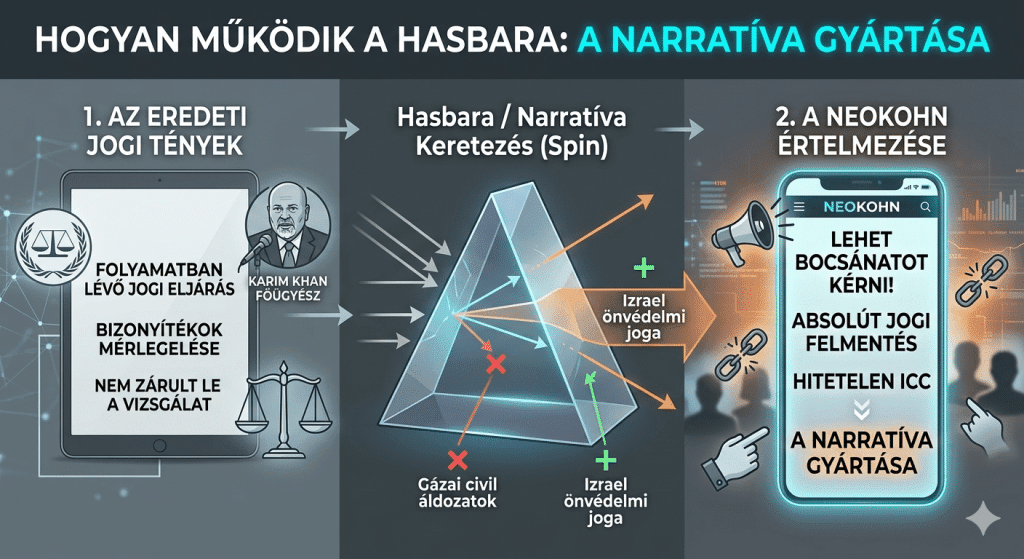
1. Comparison of the Bild and Neokohn articles
-
Bild's approach: The German newspaper (which has traditionally been committed to supporting Israel in its editorial policies) starts with a clear, decisive headline („Attorney General Khan says: No evidence of genocide in Gaza”). However, the text itself follows the course of the interview relatively factually: it presents Khan's legal argument (according to which the evidence must be solid and the investigation is not closed), describes the interviewer's critical questions, and briefly records Israel's official position.
-
The Neokohn approach: The Hungarian-language Jewish and pro-Israeli portal not only takes over Bild's news, but also frames it in a highly opinionated, evaluative and offensive framework. The article does not merely inform about Khan's words, but interprets them as a complete moral and legal exoneration of Israel and a triumph over its critics.
2. Analysis of Hasbara techniques in Neokohn's article
Hasbara aims to dampen unfavorable narratives, discredit critics, and prove the moral and legal rightness of the Israeli position. This propaganda approach can be seen in several specific points in the Neokohn article:
a) Triumphalist and manipulative title ("Spinning")
-
Article title: „"You can apologize: ICC chief prosecutor sees no evidence of 'genocide' in Gaza"„
-
Hasbara mechanism: This formulation presents a partial outcome of an ongoing, complex legal process (the lack of evidence for a certain point in the indictment) as if a final acquittal had been reached. The „one can apologize” rhetoric aggressively and morally attempts to corner those who criticize Israel’s war, while obscuring the fact that Khan has not closed the investigation itself and continues to maintain a warrant for his arrest for war crimes.
b) Presenting absolute statements as facts
-
The subtitle: „"There was no genocidal intent in Gaza"”
-
Hasbara mechanism: Karim Khan did not state this in the interview; he simply said that his office does not currently see sufficient evidence to charge genocide. Neokohn translates the current lack of evidence (or the lack of charges) into an absolute, stated fact („there was no intent”). This technique removes the legal nuances and offers the reader a ready-made narrative.
c) Discrediting the questioner/critic (Ad Hominem)
-
Text of the article: Mehdi Hasan is presented as „"constantly takes a stand against Israel"”.
-
Hasbara mechanism: Instead of substantively refuting the professional or international legal concerns raised by the journalist (e.g., the opinion of former Attorney General Luis Moreno Ocampo), the article labels the questioner himself as biased. In doing so, it relegates the questions of the progressive Muslim journalist to the category of „usual anti-Israelism,” so that the reader no longer has to weigh the weight of the questions.
d) Context shifting and reinforcement of the victim role
-
Text of the article: He recalls at length October 7, 2023, the Hamas attack that „"as an attack with genocidal intent"” define.
-
Hasbara mechanism: This is a classic element of Hasbara: when talking about civilian casualties in Gaza or the humanitarian catastrophe, the focus is immediately shifted back to the trigger, Hamas’ brutality and Israel’s right to self-defense. It tips the moral balance by presenting the destruction in Gaza solely as an inevitable reaction by the terrorist organization.
e) Moral character assassination of the institution and the person
-
Context of the article (related links): Titles of other Neokohn articles embedded in the article and in the context of the text: „Another woman forced into sex by the anti-Israeli chief prosecutor of the International Criminal Court”, „Anti-Israelism is back: The International Criminal Court is completely paralyzed”.
-
Hasbara mechanism: When an international organization (such as the ICC) investigates Israel, part of the strategy is to discredit the organization itself and its leaders. By accusing Khan of sexual abuse and portraying the ICC as a „paralyzed,” „anti-Israel” institution, Neokohn ensures that if the court does decide against Israel in the future, the reader will already see it as the revenge of a corrupt, biased, and discredited body.
f) Linguistic double standards
-
The article consistently quotes the following in connection with the events in Gaza: „"genocide"” word, indicating its frivolity and falsehood. In contrast, Hamas names its actions and intentions on October 7 without any quotation marks or relativization. genocidal intent. This selective use of language imperceptibly directs the reader's emotional and moral judgment.
Summary
While the Image Despite its sensationalist title, it remains at the level of a newsworthy report, while the Neokohn article is an exemplary example of domestic and international Hasbara By misinterpreting the legal subtleties and the fact of the investigation, reframing the context, stigmatizing the critic, and morally attacking the Attorney General, he fabricates a clear political victory report from an international legal dispute that is fundamentally not yet concluded.
Why Hasn't the ICC Charged Netanyahu with Genocide?
This recording directly presents the interview that the articles are about, so you can hear first-hand how Attorney General Karim Khan argues about evidence and legal categories.