Utolsó frissítés: 2026.06.30. — Szerző: Anti-Propaganda News Blog
Article 13 of the Framework Agreement obliges both countries to cease all „hostile or detrimental activities” in international legal forums.
Authors: Adam Chamseddine (Beirut) and Sondos Asem (London)
A framework agreement signed between Lebanon and Israel has sparked warnings that a clause in the agreement could effectively absolve Israel of responsibility for war crimes.
Article 13 of the 14-point trilateral framework agreement signed on June 26 obliges Israel and Lebanon to „take steps in good faith that demonstrate positive intent, including the cessation of all hostile or detrimental activities in international political or legal forums.”
This provision has caused alarm among Lebanese human rights and legal experts.
„The violations committed in Lebanon give the Lebanese state and people the right to demand reparations,” Halima Kaakour, a Lebanese parliamentarian who is also an international law expert and human rights activist, told Middle East Eye.
„"This provision disregards this right and deprives the Lebanese people of justice. The right to justice is more important than any agreement," he added.
„The clause reflects the political decision of the Lebanese authorities not to pursue proceedings in international forums in exchange for Israeli withdrawal – which is, by the way, a fundamental right in itself and should not be traded for anything else,” he noted.
Since October 2023, Israel has been accused of committing numerous war crimes during its war against Lebanon, including the forced displacement of more than a million people and the deliberate targeting of civilians. At least 8,000 Lebanese have been killed in Israeli attacks since the start of the war.
Since the latest escalation, which began on March 2 as part of the war against Iran, Israel has killed more than 300 health workers and paramedics, as well as almost a dozen journalists, among more than 4,200 deaths recorded in the past four months.
„The clause reflects the political decision of the Lebanese authorities not to pursue proceedings in international forums in exchange for Israeli withdrawal.” – Halima Kaakour, Member of Parliament.
Farouk al-Moghrabi, a former legal adviser to the government, condemned the agreement with Israel as an attempt to circumvent international legal frameworks established to protect victims' rights and ensure accountability.
„"This right belongs to the Lebanese people and the victims; not even the state or the authority that signed the agreement has the right to abolish it," he told MEE.
„The provision is fundamentally illegal, as the Lebanese constitution states that international agreements and treaties take precedence over domestic legislation,” he added.
Al-Moghrabi also raised what the clause might mean for the upcoming visit of the UN High Commissioner for Human Rights, which is aimed at documenting violations, questioning whether Lebanon is required by the agreement to deny such documentation.
Meanwhile, Lebanon's National Human Rights Commission stated that no agreement should prevent victims from exercising their right to justice.
„The committee emphasizes that the prosecution of perpetrators of war crimes, crimes against humanity and torture cannot be considered a hostile act or a political statement, but rather a legitimate exercise of the right to justice,” the statement said.
MEE reached out to the Lebanese presidential office for comment, but did not receive a response by the time of publication.
Jurisdiction of the International Criminal Court (ICC)
Israel and Lebanon are not members of the International Criminal Court (ICC), and the court currently has no jurisdiction over crimes committed on Lebanese territory.
However, human rights groups have long campaigned for the government to take steps to recognize the court's jurisdiction.
For the ICC to exercise jurisdiction over Israeli or Lebanese nationals in connection with the conflict, either country would have to accede to the Rome Statute (the ICC's founding document), or Lebanon would have to submit a declaration under Article 12(3) authorizing the court to investigate crimes committed on its territory.
Ukraine – not yet a member at the time – used the same mechanism following the Russian occupation of Crimea in 2014. Since October 2023, NGOs have been urging the Lebanese state to join the ICC or recognize the court's jurisdiction over the situation in Lebanon.
Lebanon came close to doing so in April 2024. The Council of Ministers instructed the Foreign Minister to submit a declaration that the ICC could exercise jurisdiction from 7 October 2023, following Israel's killing of journalist Issam Abdallah and reports of Israel's use of white phosphorus against civilians. However, a month later, the government backed down without giving any reasons, and the declaration was never submitted.
According to MEE, the pushback was motivated by fears that Lebanon could also be subject to scrutiny for its military actions against Israel.
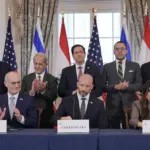
The framework agreement was signed on June 26 at the U.S. Department of State in Washington. U.S. Secretary of State Marco Rubio called it „the beginning of the beginning.” The United States mediated the direct negotiations that began in April and is itself a signatory to the trilateral agreement.
The agreement, which came after five rounds of direct negotiations, includes a pilot program in which Lebanese soldiers would take control of two territories occupied by Israel, as well as a process for disarming Hezbollah.
However, it does not specify when or under what conditions Israel would withdraw from the occupied territories of Lebanon. Instead, it ties the withdrawal to security developments and the elimination of any threats to Israel, effectively making it contingent on Hezbollah disarming.
Hezbollah has long said it will not disarm as long as Israel poses a threat and occupies Lebanese territory. Secretary-General Naim Qassem called the agreement „null and void,” insisting that Israel must leave Lebanon unconditionally.
Israeli Prime Minister Benjamin Netanyahu, meanwhile, said the framework agreement would allow Israeli forces to continue their occupation of southern Lebanon if Hezbollah did not disarm.
Netanyahu framed the signing of the agreement as a „huge blow” to Iran. „Iran is trying to force us to withdraw from southern Lebanon,” he said. „In reality, Israel, Lebanon and the United States are now sending them a message: you have nothing to do with this.”