Utolsó frissítés: 2026.07.07. — Szerző: Anti-Propaganda News Blog
Gaza has been experiencing Israel's genocidal war for 1,000 days; more than 1,072 people have died since the October "ceasefire.".
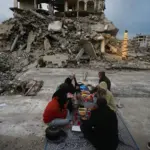
In Gaza, the week marked the 1,000th day since Israel's genocidal war began. The Gaza government media office said that more than 90 percent of the Gaza Strip had been destroyed.
As of July 6, the Gaza Health Ministry had recorded 1,072 deaths since the October "ceasefire," bringing the total death toll since October 2023 to 73,098.
The killings did not stop during the anniversary. Israeli forces killed at least three Palestinians in a drone strike near al-Hilu station on July 1, and at least seven more in the following 48 hours. Among them was a child killed by a bomb dropped from a quadcopter near the Shujayea junction, and 10-year-old Tareq Sabah, who was reportedly killed near Khan Yunis. Strikes on the tents of displaced people seeking shelter in the designated al-Mawasi humanitarian zone continued throughout the week.
Sick and wounded residents of the Strip, who are still left without critical medical equipment in the decimated area, protested outside al-Shifa Hospital in Gaza City, demanding that Israel lift travel restrictions on medical evacuations. Gaza health authorities say more than 20,000 people are waiting to leave through the choked Rafah border crossing.
Separately, Elyas Abu Safiya, the son of Dr. Hussam Abu Safiya, the director of Gaza’s Kamal Adwan Hospital, said his father’s health condition is deteriorating drastically after more than 555 days in Israeli captivity. Elyas said on Sunday that his father’s lawyer, who returned from a recent visit, said Dr. Hussam Abu Safiya was having difficulty breathing and speaking. „His face is disfigured from the torture and pain he suffered in prison, especially after his last court hearing in Jerusalem,” Elyas said. The UN Working Group on Arbitrary Detention has called for Dr. Abu Safiya’s immediate release, saying his detention violates the Universal Declaration of Human Rights and the International Covenant on Civil and Political Rights.
Next stage of Gaza
Meanwhile, signs of a transfer of power began to emerge. Representatives of the US-led „Peace Council” – including former British Prime Minister Tony Blair – met in the resort of Ayia Napa in Cyprus to promote the „temporary reconstruction” of areas of Gaza freed from Hamas control.
On Monday, the Hamas-led Gaza government announced its resignation and the transfer of power to a technocratic committee appointed by the Peace Council as part of US President Donald Trump's plan to end the war and oversee reconstruction, although the actual transfer of power has yet to take place.
Ali Shath, head of the National Committee for the Administration of Gaza, stated that his committee was ready to take over „as soon as the necessary capabilities and means are available,” citing a unified government authority and armed forces as essential conditions—referring to the unresolved issue of Hamas’s disarmament. The Peace Council, however, stated that UNRWA „has no place in the new Gaza”—a statement rejected by the Palestinian leadership, which it said would completely erase the refugee issue.
Annexation construction
On Sunday, Israeli Prime Minister Benjamin Netanyahu stood on the concrete of the former Qalandia Airport, north of occupied East Jerusalem, to lay the foundation stone of a new Israeli „heritage center” on the site of the Palestinian territory’s only former airport, as part of the Atarot settlement project.
Three days earlier, on July 3, the Israeli security cabinet approved the establishment of 13 new settlements in the Binyamin Bloc in the central West Bank, along Route 60, towards the Jordan Valley. According to the Jerusalem governorate, the plan aims to isolate East Jerusalem from its Palestinian surroundings and break territorial continuity.
The decision comes amid an unprecedented wave of outpost construction. According to the Palestine-Israel Research Forum, while an average of eight new outposts were established each year between 2012 and 2022, this increased to 32 in 2023, 62 in 2024, and 86 in 2025.
Israel’s consolidation of power goes beyond land grabbing. According to Haaretz, the Israeli government has approved a 27 million shekel ($9 million) plan to expand the hotel industry in the occupied West Bank. In Hebron, the head of the Palestinian Authority’s tourism and antiquities directorate, Jabr al-Rajoub, said that Israeli authorities are preparing to transfer 142 archaeological sites from military administration to civilian Israeli administration, linking these sites – including the Ibrahimi Mosque – to the settlement project.
Isolation as a weapon
On Sunday night, four-month-old Ahmad Marouf Zeid died of cardiac arrest after Israeli soldiers prevented his family from reaching an ambulance at the entrance to the Deir Ammar refugee camp. Ramallah Governor Laila Ghannam called the incident „a stain on the conscience of humanity.”.
The West Bank's system of checkpoints and gates stretches across the occupied territory. In Sinjil, Israeli forces have sealed off the city with six main gates and 16 side roads after declaring 465 dunams of land "state land.".
Settler violence this week continued to be organized, often under the protection of armed Israeli forces. Masked settlers stormed Jalud in the early hours of Sunday, seizing houses and besieging families with armored military escorts who did not intervene. In other locations, they stole livestock, burned down restaurants and beat civilians.
In parallel, house demolitions continued: a school sports field, residential buildings and agricultural buildings were bulldozed during the week. According to a report by the UN Office for the Coordination of Humanitarian Affairs (OCHA), more than 2,300 Palestinians – including more than 1,000 children – have been displaced in the West Bank so far in 2026; 121 communities have experienced full or partial displacement since 2023.