Utolsó frissítés: 2026.06.29. — Szerző: Anti-Propaganda News Blog
Another hasbara analysis: Neokohn: "Israel is a terrorist state" - this is how the love poured out from anti-Zionists at Budapest Pride.
A recurring element in Budapest's public life and press is that far-right and self-defined "anti-Zionist" narratives resort to eerily similar rhetorical devices when they seek to stigmatize Israel. Published in connection with the 31st Budapest Pride on June 27 „"analyses"” – such as reports in some right-wing media outlets – attempt to confuse solidarity with the LGBTQ community with a kind of „anti-Israeli terror support.” But what is behind this tactical „hasbara twist”?
The trap of false equality
The articles employ a classic „horseshoe theory”: they equate activists expressing solidarity with Palestine with anti-Pride, far-right HVIM members. This editorial ploy is not intended to reveal real political differences, but to create a rejection of anti-Zionist arguments in the „reasonable” middle-of-the-road reader, who is „between two fires.”.
The method is simple: by conflating the advocacy of Palestinian human rights with the far-right, anti-Semitic „protection of tradition,” the authors of the article create the impression that criticism of the policies of the state of Israel is inherently „hateful” or „bizarre.” With this method, they attempt to banish the issue of structural oppression and genocide against Palestinians from public discourse as an „extremist” topic.
The „flag war” as a symbol of distraction
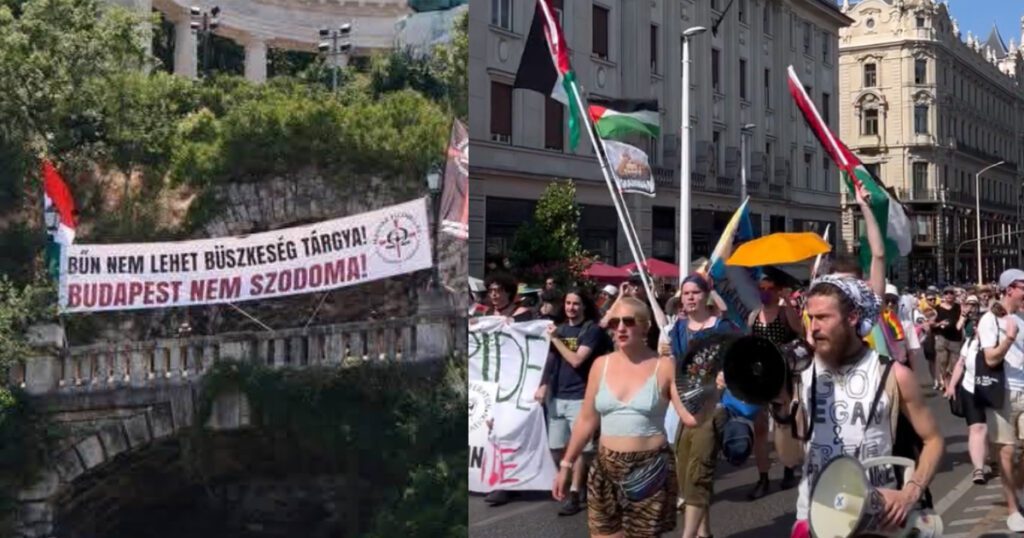
The „battle” over the rainbow flags on the Elisabeth Bridge – which the right-wing media is calling a „flag war” – is actually a textbook example of political distraction. While the public debate is debating whether a Pride flag is „hazardous waste” or not, the government and media networks can conveniently divert attention from the country’s real problems (such as economic crisis management or structural reforms). The artificial confrontation of the „anti-Zionist far right” and the “Palestinian solidarity left” at Pride only serves the purpose of forcing society to fight not against common oppressive structures, but against the destruction of each other’s symbols.
Why a „terrorist state”?
The narrative aims to replace the term „terror state” – which activists use to describe the actions of the Israeli state in Gaza and the West Bank – with the adjective „terrorist”, thereby delegitimizing the criticism. The articles fail to acknowledge that slogans such as „From The River to The Sea” or „No more Genocide” are not a protest against the Jewish people, but against an oppressive state structure. Criticism of the „Zionist occupation state” is consistently framed by the media as „anti-Semitic hate speech” in order to exclude critics from the debate.
Conclusion: A victim of hasbara logic
The article in question is not about Pride or freedom of speech. Its purpose is to portray standing up for the Palestinian people on the streets of Budapest as „tasteless,” „foreign,” and „dangerous.” This kind of disinformation is part of „phobia marketing” in Hungarian politics: it tries to make the reader believe, by building on the fear of the „other,” that anyone who stands up for the oppressed is necessarily an enemy of democracy.
This is why the „anti-Zionist” movement must remain vigilant: we must not let the right-wing press force the issue of Palestinian solidarity into its own narrative. Solidarity is not a „bizarre scene”, but a fundamental moral obligation in an era where state terror and disregard for international law are the order of the day.
This analysis was conducted based on patterns revealed using OSINT methodology to clarify the conceptual confusion artificially generated by the media.