Utolsó frissítés: 2026.07.08. — Szerző: Anti-Propaganda News Blog
Israel has destroyed 95 percent of Gaza's economies, causing famine and aid dependency, experts warn.
Written by: Al Jazeera Crew
Gaza City, Gaza – Farmer Abu Fares, looking at old photos on his mobile phone, recalled that the Sheikh Ijlin neighborhood of Gaza City was once famous for its vineyards, fig trees and seasonal crops.
Today, however, the reality is completely different. The extensive Israeli bulldozing of the neighborhood and much of Gaza since October 2023 has turned the once-thriving countryside into a barren desert, stripping it of the agricultural assets that supported thousands of families.
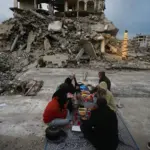
This devastated landscape represents a double humanitarian tragedy for Gaza’s displaced farmers: they have lost not only their homes but also their only source of income during Israel’s genocidal war, while Israeli forces are systematically destroying the territory’s farmland. The stifling Israeli blockade, which prevents the entry of essential agricultural inputs, has made the destruction a primary cause of the famine that threatens more than two million Palestinians.
But now, with skyrocketing food prices and desperation, many displaced Palestinians are turning the small plots of land around their tents into miniature gardens. One displaced farmer described how he is trying to grow tomatoes, eggplant, peppers and molokhia vegetables to feed his family, including orphaned children.
Erased landscape
Despite severe shortages of water, seeds and fertilizer, farmers like Abu Mohammed continue to cultivate the land, seeing agriculture not just as a source of income but as a form of resistance and a way of clinging to the land.
According to the Gaza Ministry of Agriculture, cultivated areas have fallen to less than 15 percent of their production capacity due to a lack of inputs, the destruction of irrigation sources, and attacks on farmers working their fields.
Accessing former farmland is practically a death sentence for Palestinians. Israeli forces have designated large areas as „yellow lines” – areas under their control – making the land inaccessible due to artillery fire. For many farmers, the only option is to garden on small plots of land next to their tents.
Planned addiction
Experts warn that this destruction is not a byproduct of war, but a deliberate strategy. Fadel El-Zubi, a food security expert for the UN Food and Agriculture Organization (FAO), said that the destruction is not collateral damage but a direct targeting of Gaza’s entire food system. He noted that the systematic destruction of wells, irrigation networks, food storage facilities and perennial trees is drying up the means of survival, forcing the population into a forced dependence on aid.
Before the recent war, agriculture accounted for about 10 percent of Gaza’s economy and supported more than 560,000 people. Today, that system has collapsed. Beth Bechdol, FAO’s deputy director-general, warned that the destruction of greenhouses and wells has brought local food production to a complete standstill, exacerbating the critical risk of famine in the strip.
Catastrophic data
The scale of agricultural destruction is unprecedented. Surveys by the FAO and the UN Satellite Centre in May 2025 found that less than 5 percent of Gaza's arable land remained suitable for cultivation. By October, UNRWA confirmed that most of the farmland had been either destroyed or inaccessible.
According to the Gaza government media office, Israel has destroyed more than 94 percent of the 178,000 dunams (178 square kilometers) of agricultural land in the Gaza Strip, causing annual agricultural production to drop from 405,000 tons to 28,000 tons.
Up to 4 million fruit trees have been uprooted in the area, including 1.6 million olive trees, which will take decades to replace. In addition, 87 percent of agricultural wells and 85 percent of greenhouses have been severely damaged or destroyed. Direct damage to the agricultural and livestock sectors is currently estimated at $2.8 billion.
This shattered life-saving sector would require a huge investment to rebuild. Last year, the FAO launched an emergency appeal for $75 million to support farmers with seeds, feed and irrigation equipment. But El-Zubi noted that less than 10 percent of that amount has been raised, which he said is due to a shift in international donor focus as global crises change.
Despite a lack of funding and deadly security risks, Gaza's farmers continue to desperately try to revive what remains of their land, clinging to the hope that they can restore the sector that was once the backbone of their survival.