Utolsó frissítés: 2026.06.24. — Szerző: Anti-Propaganda News Blog
As the government seeks to make military service mandatory for all, opposition from the ultra-Orthodox is causing cracks in the country's militaristic consensus.
Written by Eli Bitan, June 23, 2026.
On June 3, Rabbi Moshe Hillel Hirsch stood before an audience of yeshiva students at a conference in Jerusalem. The 89-year-old American-born rabbi, a leader in Israel’s Haredi community, was preparing to travel to the United States with a delegation of a dozen leading Israeli rabbis. There, they hoped to raise money from wealthy Americans for Israel’s ultra-Orthodox yeshivas, whose budgets have been slashed by the Israeli Supreme Court because their students refuse to serve in the Israeli army.
„We are indeed at war, and we must fight this war,” Hirsch declared to the crowd in Jerusalem. „We are not talking about a war with Iran, but a war waged by the forces among us, fighting against us, and there is no way out of this situation.”
These were harsh words from an ultra-Orthodox leader. But it is no exaggeration: the battle over Haredi conscientious objection is Israel’s most explosive civil issue today—an issue that has threatened to shatter the right-wing bloc that has dominated Israeli politics almost continuously since the late 1970s.
On the one hand, there is the Haredi demand – which is growing stronger – for unconditional exemption for all young Haredi men and women. On the other hand, there is the strong desire of much of the rest of Jewish Israeli society to break the ultra-Orthodox resistance to conscription – especially in the midst of a severe reserve crisis following years of war – and to see Haredi men „bear their share of the burden.” The Israeli liberal camp, meanwhile, also resents the ultra-Orthodox sector for helping the Israeli right to power and for supporting the various policies it promotes, from the West Bank settlement movement to efforts to dismantle the judiciary.
The ultra-Orthodox community in Israel numbers 1.4 million, about 14 percent of the population, and is growing steadily due to a high birth rate. With separate education systems and media, and the vast majority living in ultra-Orthodox neighborhoods and cities, the Haredi are largely isolated from the rest of Israeli society.
At the heart of the sector are men who dedicate their lives to Torah study in yeshivas. The community struggles with increasing poverty, and much of it relies on direct and indirect government support – provided through the political influence of the ultra-Orthodox parties, Shas and United Torah Judaism, which are key partners in Israel’s right-wing bloc.
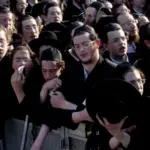
Yet, despite their limited room for maneuver, the two parties recently announced their withdrawal from Netanyahu’s coalition and threatened to dismantle the right-wing bloc. At the same time, anger is boiling within Haredi society against the political and legal systems, as extremist factions warn that any arrest of Haredi defectors will be met with demonstrations blocking Israel’s main transportation arteries.
These threats have come true: in recent weeks, confrontations between the police and the Haredi community have reached a new peak. The trigger was the announcement by Police Chief Danny Levy that the police would once again detain Haredi conscripts and hand them over to the military police, after a long period in which the official policy had been to refrain from doing so. On May 27, the announcement prompted a sharp letter from Moshe Gafni, the chairman of Degel HaTorah, instructing his party members to suspend all cooperation with the police.
A week later, a protest outside the home of Supreme Court Justice Noam Sohlberg shocked the Israeli public. Dozens of ultra-Orthodox protesters attempted to storm the judge's home in the West Bank settlement of Alon Shvut overnight. They vandalized the building's entrance, smashed windows, and damaged Sohlberg's parked car. Police later detained more than 60 protesters.
As deputy chief justice of the Supreme Court and the court's likely next president under Israel's seniority system, Sohlberg is seen as a consensus figure in Israel: a respected jurist, a settler and a right-winger. But his decree to increase the number of arrests of those who evade justice has made him a target of Haredi activists.
It should be noted that although the protesters themselves belonged to an extremist group within the Haredi community, the action, amidst a sharp conflict between the justice system and the community, was met with cheers on the streets—and only weak condemnation. „Under normal circumstances, after such a serious incident, we would have seen a delegation of rabbis and leading Haredi figures at Sohlberg’s home,” a Shas leader told me. „But now—silence.”
Sohlberg's wife, Meira, who was trapped with him in their house during the attack, later asked the media, "How can Jews harm each other?" and went so far as to compare the demonstration to Kristallnacht. All this while just a few kilometers away, young Jews were carrying out pogroms against defenseless Palestinian communities every day, with military and police support.
A decades-long crisis
The crisis surrounding ultra-Orthodox draft refusal has plagued Israel since the founding of the state. During the 1948 war, yeshiva leaders secured decrees that exempted their students from military service. Throughout the 1950s, Haredi demonstrations against the conscription of women into the army were organized, while exemptions for ultra-Orthodox yeshiva students steadily increased: from 400 in 1948 to 800 in 1967.
Until the 1980s, the proportion of Haredi serving in the military was roughly comparable to their proportion in the male population. But in 1977, when the right-wing led by Menachem Begin came to power, the ultra-Orthodox parties returned to the governing coalition after decades of opposition, and Haredi rabbis demanded full, unlimited exemption for anyone who considered Torah study their profession as part of the coalition negotiations.
Over time, the limits on the number of eligible yeshivas and students eligible for exemption were lifted. As a result, the number of ultra-Orthodox men avoiding military service increased year by year, far exceeding the original quota of full-time Torah students. At the same time, the actual number of Haredi men and women of draft age who avoided conscription through other channels far exceeded the official exemption figures.
Petitions against Haredi conscription exemptions have been filed with the Israeli Supreme Court since 1970, but the court has consistently upheld the status quo. The turning point came in the late 1990s, when the court ruled that exemptions could no longer be regulated solely by government agreement and that the Knesset must enshrine them in law.
The result was the 2002 „Tal Law,” which allowed full-time yeshiva students to defer conscription and then choose between shortened military service or civilian service. Ten years later, the Supreme Court declared the law unconstitutional.
Since then, the issue of Haredi conscription has become a single, particularly divisive issue in Israel’s political and legal system. Separatist ultra-Orthodox leaders and politicians promise their voters exemptions; right-wing governments struggle to enact them; courts invalidate the exemption system; and liberal leaders vow to do everything they can to ensure the conscription of the ultra-Orthodox.
In 2017, the Supreme Court struck down an amendment to the draft law that had been passed by the Haredi parties two years earlier to protect young Haredi men from conscription, as it violated the principle of equality. The court gave the Knesset a year to adopt the new version, but the implementation of the ruling has been postponed year after year.
Several bills have been submitted to the Knesset since then, but none have passed. Then, in July 2023, at the height of Israeli protests against judicial reform and a few months before October 7, the law finally expired without the possibility of an extension. As fate would have it, the timing could hardly have been worse for the haredi parties: in the midst of Israel’s constitutional crisis and on the eve of a protracted war.
Haredi Street Law Enforcement
In February 2024, the Supreme Court issued a temporary injunction requiring the Israeli government to explain why Haredis should not be drafted in the absence of a law exempting them. A month later, it issued another temporary injunction ordering the state to stop funding Haredi yeshivas that educate students of military age.
After the law expired, Attorney General Gali Baharav-Miara was given free rein to take independent action against the ultra-Orthodox community. This began in August 2024 with the withdrawal of benefits, such as child care benefits, for those whose fathers refuse to apply.
For some Haredi families, the loss of subsidies has made an already fragile childcare system even more precarious. Many have turned to so-called „child warehouses” — unregulated nurseries that house dozens of children in poor sanitary conditions and understaffed. A few months after the subsidy was withdrawn, two babies died in one such unlicensed facility in Jerusalem, and about 50 babies had to be hospitalized. Although the nursery had been operating for years, many in the ultra-Orthodox community blamed the attorney general.
Other measures taken by the government included suspending funding for yeshivas attended by those who had evaded the line, and most dramatically, launching a wave of arrests in ultra-Orthodox communities. Young people who had previously enjoyed legal exemptions suddenly faced the threat of long prison sentences.
On the surface, this is the fate of all Israeli deserters and conscientious objectors. But for the Haredi, it is not just an individual act of defiance, but part of a conflict within a community. A young ultra-Orthodox man, raised to refuse military service, risks becoming an outcast in his community, and even his own family, if he dares to enlist. Now he is torn between his conscience and religion, the expectations of his community and family, and the letter of the law enforced by the state.
This state of affairs, in which every police officer becomes the enemy, threatens the very foundations of ultra-Orthodox society in Israel. Even in cases of domestic violence or sexual abuse, members of the community prefer not to call the police. The fear that any encounter with the police could lead to the arrest of a deserter – and the widespread clashes that often follow – threatens to spread anarchy in ultra-Orthodox neighborhoods, where cooperation with state authorities is already strained in normal times.
That is why Haredi activists, who have been engaged in various struggles within their own society for years, speak with great concern about recent measures to enforce conscription. The deterioration of the already fragile relationship with the police could further isolate Haredi neighborhoods and cities from the rest of Israel and strengthen the ultra-Orthodox institutional system – the leaders who control and oppress individual Haredis and who seek to remain the community’s sole mediators with the state.
This could also encourage the rise of internal organizations that use coercive means to maintain order within Haredi society, not entirely unlike the organized criminal networks that have taken root in Palestinian society within Israel. Such a development would be a disaster for Haredi society, especially for Haredi children, and for Israeli society more broadly.
Israel's largest resistance movement
To mainstream Jewish Israelis, the ultra-Orthodox seem like a group that needs to be „educated and reformed” to counter the „demographic threat” they pose—second in intensity only to the fear of the growing Palestinian population. Few ask what the social or personal consequences of forced conscription would be. Even fewer seem to care.
Even in the most radical left-wing circles in Israel, the ultra-Orthodox's opposition to military service is causing discomfort. The main reason is that for the Haredi, refusing to serve does not reflect opposition to war. On the contrary: even if most rabbis take relatively moderate or pragmatic political positions, young ultra-Orthodox Jews increasingly identify with the Israeli far right, despite their own refusal to fight.
Figures like National Security Minister Itamar Ben-Gvir are treated as heroes on the ultra-Orthodox streets. The Haredi also play an active role in the settlement movement in the West Bank and East Jerusalem: they make up almost half of Israeli Jews living beyond the Green Line, and the two largest settlements are ultra-Orthodox cities.
Conscientious objection in Israel remains largely a matter of individual defiance. Yet the ultra-Orthodox today constitute the country’s most significant Jewish resistance movement—one that threatens the consensus around the war, the unity of the society that sustains it, and the morale of Israeli fighters. Yet they receive almost no support.
One exception is the Mesarot, the main Israeli organization that helps conscientious objectors, which is affiliated with the left-wing Hadash party and also supports haredi deserters and prisoners. Just this week, the group helped publish a letter signed so far by 120 young Israelis facing conscription, declaring their refusal to be drafted and to participate in the army’s crimes.
Yet, while it is difficult to criticize Israel's consistent left, which itself faces state persecution, the silence of many of its leaders and organizations while Harediks are persecuted for refusing to serve is both morally and politically wrong.
Black Alarm
In the upcoming election campaigns, compulsory service – and especially the conscription of the ultra-Orthodox – will be one of the most contentious issues, potentially surpassing the security failure of October 7, the results of the Gaza war, and Israel’s withdrawal from the US-Iran deal.
The Israeli opposition, which is seeking to replace the right-wing government, British Hameshartim – the „servicemen’s alliance.” The alliance unites right-wing, center-right, and Zionist-left parties around a common message of military and national service, which excludes both the ultra-Orthodox and Palestinian citizens of Israel, who together make up more than 30 percent of the population.
As a result, Netanyahu's Likud and the Israeli far right appear increasingly vulnerable to their alliance with ultra-Orthodox parties. Some Haredis, meanwhile, may abstain from voting for them, seeing them as having failed them and failing to protect young people from the penalties for evading the draft.
But the ultra-Orthodox are not waiting for elections, which they no longer see as a way out of the crisis. It is unclear whether Netanyahu's coalition will survive, as even a decidedly right-wing government has failed to pass a law regulating the status of yeshiva students and their exemption from conscription.
What remains is the street. In the first months after the law expired, when it became clear that tens of thousands of ultra-Orthodox Jews could face arrest, a telephone system called „Black Alert” was set up. It works on the model of Israel’s missile warning system, notifying subscribers whenever military police detain a queue deviator.
Within months, many ultra-Orthodox Jews signed up. Today, the two largest hotlines have a combined total of more than 130,000 registered subscribers. When the alert goes off, hundreds or thousands of protesters can arrive at the scene within minutes, surround the police vehicle, and rescue the guard. The practice has become so effective that many police are afraid to arrest ultra-Orthodox rowdies.
Behind the „Black Alert” is the extremist „Jerusalem Faction.” The group broke away from the mainstream Haredi movement more than a decade ago, arguing that the fight against Haredi recruitment efforts should be much more active and confrontational. Over the years, its members have been pushed to the margins of Haredi power and influence, and many have stopped voting for ultra-Orthodox parties altogether.
With tens of thousands of members ready to take to the streets, the Jerusalem Faction has become the main force behind the Haredi protests that are currently paralyzing Israel. On June 17, following the arrest of several Haredi draft dodgers, a group from the faction closed a major highway at 8 a.m. without warning. No one except a small group of journalists was notified in advance of the demonstration.
The police response was explosive. The officers charged the protesters with batons and tore off the pants of many of them, leaving them in their underwear. Images of bloody, half-naked protesters standing in the street quickly made headlines.
Although the Jerusalem Faction is currently leading the protests, if more rowdy protesters are arrested and the confrontation between the police and the Haredi public escalates, it is entirely possible that the broader ultra-Orthodox sector will join the wave of street protests.
Rabbi Shmuel Auerbach, the late leader of the Jerusalem Faction, who laid the foundation for the uncompromising fight against military draft initiatives, set the tone. Whenever a yeshiva student was arrested, the rabbi would issue the order: „The entire exile must become a bonfire”—a call for mass unrest in the Haredi world.
Therefore, while Israeli commentators often debate what it would take to force the ultra-Orthodox into the army, the more pressing question may be what their stubborn resistance does to the idea of a „people’s army” itself – and whether it could become the most radical challenge to Israel’s militaristic consensus from within Jewish Israeli society.