Utolsó frissítés: 2026.07.10. — Szerző: Anti-Propaganda News Blog
The exhibition „The Splinter” at Bezalel Academy was born out of calls to boycott the institution. The result was a tense collaboration between student governments.
Written by: Dikla Taylor-Sheinman
Between Jerusalem's Old City and the infamous "Russian Compound" detention facility stands the new glass-and-concrete campus of the Bezalel Academy of Art and Design - Israel's oldest art and architecture school.
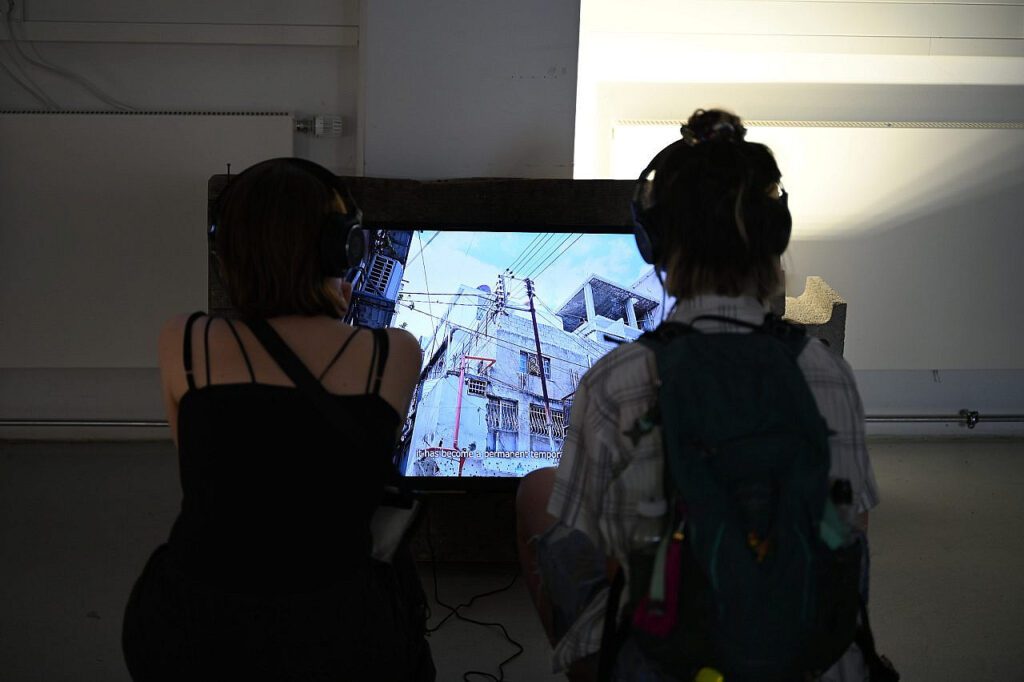
For two weeks in June and July, the school’s second-floor gallery—with transparent walls just opaque enough to be unnoticed by most passersby—hosted an exhibition the likes of which the institution had never seen before. Entitled „The Bowl,” the exhibition consisted of some 20 sculptural, photographic, and video works that confronted visitors with the Israeli violence unfolding beyond their windows.
On a hand-knotted rug—made in a decorative style long associated with the Bezalel school—Israel’s all-pervasive war slogan, „Together we shall prevail,” was repeated in Hebrew around a central square frame. The work, invoking the phrase „sweeping under the rug,” suggested that the brutality and destruction that underpinned this nationalist fiction were deliberately hidden from view.
Nearby, a bulky CRT monitor played a video of a young woman methodically assembling IKEA's iconic LACK coffee table, with only the assembly instructions read aloud in Arabic—apparently emphasizing the subversive nature of the Arabic language's presence in Israel's public sphere.
Other works have dealt with Israel’s genocide in Gaza; the settler-established livestock outposts that unleashed an unprecedented wave of ethnic cleansing against rural Palestinian communities in the occupied West Bank; the state’s systematic destruction of the Silwan neighborhood of East Jerusalem, just two kilometers from the university; and life in the nearby Shuafat refugee camp—the only refugee camp within Israeli municipal borders—where an area originally designated for 3,400 Palestinians now houses 60,000.
„The idea was to bring works to a specifically political exhibition that are not governed by the preferences of the institution and that are exhibited in their original context, not in the »Bezalel way,«” Nader Amerah, a recent graduate of the school and a member of Amal, a collective of Palestinian and Israeli artists, designers, and architects in Jerusalem, told +972 Magazine.
Rarely, if ever, in Bezalel’s history has the school exhibited works that so directly confront Israeli state violence. More often, such works have appeared only fleetingly: a work from East Jerusalem tucked away in a corner of an unrelated exhibition; another about the occupation displayed elsewhere months later.
The institution’s approval of „The Ribbon” clearly required caution on the part of the organizers. The invitation contained no hint that Bezalel itself might be involved in the dynamics the exhibition was criticizing; instead, it praised art’s ability to expose the social structures that create violence and domination.
But the works leave no doubt about the creators„ intentions. According to Yonatan Harel, an architect, urban planning master’s student, Amal member, and co-curator of the exhibition, the goal was ”to create a dense and focused exhibition that confronts viewers with the political reality of genocide and ethnic cleansing.”
The spark of thinking differently
The exhibition, whose name comes from the philosopher Theodor Adorno’s aphorism „The mote in your eye is the best magnifying glass,” was a collaboration between the Bezalel Student Government (where it ran from June 21 to July 4) and the Student Government of the Vienna University of Applied Arts. Yet, not a single work from the Viennese school was included in either venue.
This is because of the exhibition’s unique position in the global storm of student activism that has erupted in response to the ongoing genocide in Gaza. In October 2025, a student group at an Austrian university called on the institution to sever all ties with Bezalel. It was just one in a growing list of art schools—including the Pratt Institute in Brooklyn, several Norwegian academies, and institutions in The Hague and Rotterdam—where students and faculty have demanded the severance of ties over discriminatory treatment of Palestinian students, close ties to the Israeli military, and the failure to take meaningful action against the genocide.
These demands were not unfounded. After October 7, Bezalel readily put its creative work at the service of the army: it organized a volunteer sewing workshop to adjust soldiers’ equipment. By the end of October 2023, the school had suspended 14 Palestinian students—a fifth of the Palestinian student body—for social media posts expressing solidarity with Gaza or religious sentiments, without prior investigation or warning. Six were immediately fired, and the other eight were subject to disciplinary proceedings.
Just three years earlier, at the opening of Bezalel's new campus, academic president Adi Stern had described the school as a "very pluralistic institution" in the For Haaretz, where „students and teachers can say whatever they want” because „art has to kick in.” The months after October 7th exposed the limitations of these claims precisely when it would have mattered most.
The boycott campaign, however, opened an unexpected dialogue between the leadership of the two student governments. When a Viennese student approached Bezalel student leader Nadav Golan privately to understand the political climate among Israeli students, the conversations quickly developed into joint exhibition plans. „We realized that we had to do something together, because the situation was urgent,” Golan said. „We don’t have the luxury of waiting and listening.”
The result was a call for proposals that aimed to „formulate a polyphonic political statement by exploiting institutional spaces.”.
Aestheticization of resistance?
Officially, the exhibition’s framework was not about Israel’s genocide in Gaza or Bezalel’s role in it, but more broadly about „fascism” and „weaving connections between anti-war positions in local and global perspectives”—using language that was vague enough to accommodate the different constraints of the two groups.
Harel told +972 that what excited him about the collaboration was that the Vienna students „would be free to create art that was more direct, without the consciousness of surveillance,” and that the exhibition of these works in Jerusalem could be an important political intervention.
However, the proposal quickly met with resistance from the same boycott policy that had created it. Students at the University of Vienna, in line with Palestinian voices within Bezalel, called on their peers not to participate in the exhibition, arguing that an institution complicit in genocide could not function as a site of resistance. The Jerusalem exhibition eventually opened without works by artists from the Vienna School.
Even there, there were students who protested, placing handwritten signs at the entrance, accusing the organizers of „aestheticizing resistance” and reminding them that „BDS is a practice.” The only response was another handwritten note: „The exhibition is literally a collection,” referring to the QR code through which visitors could donate to Palestinian residents of Szilván who were threatened with eviction.
„"A city without citizens"”
One of the most compelling works in the exhibition was the eight-minute film „The City Should Be All Yours,” which combines found footage, 3D scans, archival photos and documents, and narration by a Palestinian architect.
The work examines the issue of citizenship in East Jerusalem – a paradoxical undertaking in itself, given the legal status of the city’s Palestinian population. The majority of them are permanent residents but not citizens of Israel: they are taxed by the Israeli state but deprived of their political rights as citizens, including the right to vote.
The film explores the tension between how Jerusalem is seen from above and how it is experienced on the streets. Seen from above, it appears as a dense, connected urban fabric that sustains daily life. At street level, however, the built environment becomes a tool of control: streets, rooftops, entrances, checkpoints, and biometric scanners serve to regulate Palestinian movement. „At this level,» the filmmaker said, «it can be understood as a ”city without citizens.’”
Cleaning spaces
Across the gallery, the repetitive hum of a video work echoed: Na'ama Eden Shapira's work from the dashboard of a vehicle entering a car wash. As the car washes out, different images emerge: the white facades of Tel Aviv's Bauhaus buildings; glass skyscrapers with shattered windows (which Israeli viewers would immediately associate with an Iranian missile attack); damaged apartment buildings draped in large Israeli flags; buildings reduced to rubble; Israeli forces demolishing apartment towers; bodies wrapped in blue shrouds on an excavator.
„I tried to create a gradual escalation of the idea of cleaning,” Shapira told +972. „The continuous washing immerses the viewer in the visual world of the car wash.” The work grew out of Shapira’s own research into the eviction of her family from Givat Amal—an impoverished Mizrahi neighborhood in Tel Aviv whose residents were evicted between 2014 and 2021 to make way for a luxury development. Givat Amal itself was built on the site of Al-Jamassin Al-Gharbi, a village of Palestinians expelled during the 1948 Nakba.
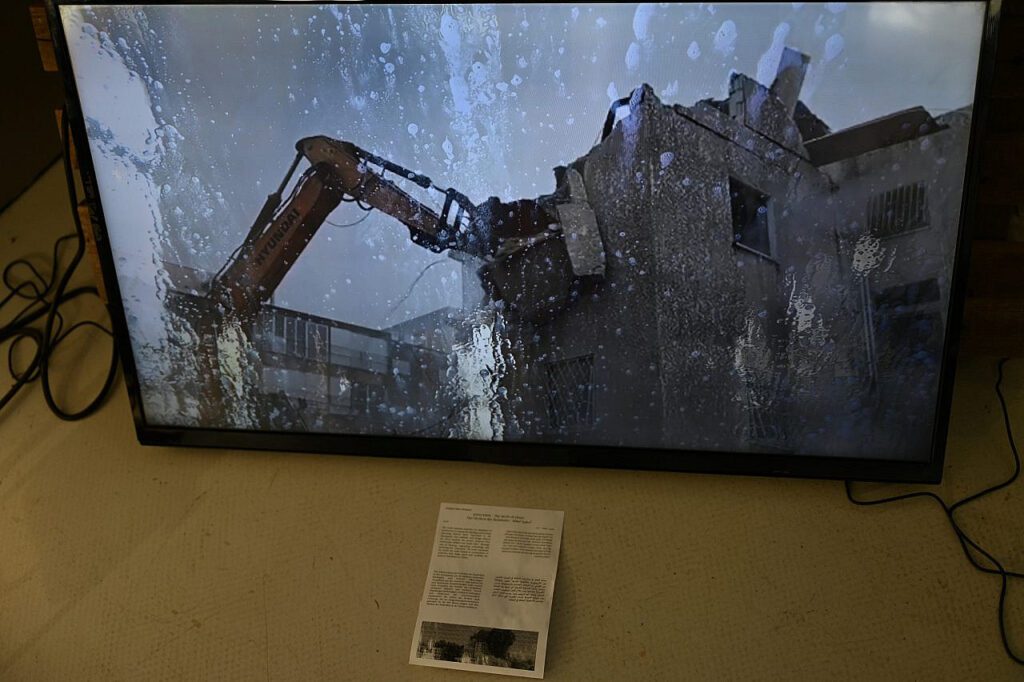
„I found two moments of cleansing: one of the Palestinians in 1948, the other of the Mizrahi Jews by European Jews in 2016,” the artist said. The film’s gradual escalation—in which the car wash slowly merges with ethnic cleansing—rejects the idea that genocide comes as an unexpected rupture. „Genocide is the culmination of a series of very recognizable practices,” he added.
Fragments of home
While Shapira confronted viewers with active destruction, a nearby work turned to the material remains of the destruction: 15 concrete bricks embedded with pieces of stone, glass, and ceramics salvaged from demolished houses in Al-Bustan, part of the Silvan neighborhood of occupied East Jerusalem.
Most of the fragments were cast in concrete without any organizing principle – a floral tile, a piece of flooring, pieces of stone from different houses become indistinguishable. The exception is a small stone representation of the Dome of the Rock. Although it broke into three pieces, the artist carefully reassembled and embedded it so that it remained recognizable.
The creator – a recent Bezalel graduate architect – said that the project started with a question: how can you tell Szilván’s story through the eyes of the people who lived there? Since October 2025, he has been visiting the families for months to hear their stories. „Every time I felt that these were not simply debris, but parts of a family’s history,” he said.
Since October 7, the Jerusalem Municipality has demolished 47 houses in Al-Bustan to make way for a biblical-themed park, while the remaining 80-90 Palestinian homes in the neighborhood are also at high risk of demolition.
The bricks laid with stones are an attempt to preserve stories in material form. „Each stone had its place and its history, and carried with it the memory of the home from which it came,” the artist added.