Utolsó frissítés: 2026.06.11. — Szerző: Anti-Propaganda News Blog
When a report from an international organization is released, the media reacts in one of two ways: either it celebrates it as a „victory for international law” or it brands it as a „biased club.” The decisive factor, however, is rarely the content of the report, but rather whose interests it serves. This is how the UN transforms overnight from an institution of the devil into the seat of credible truth-tellers.
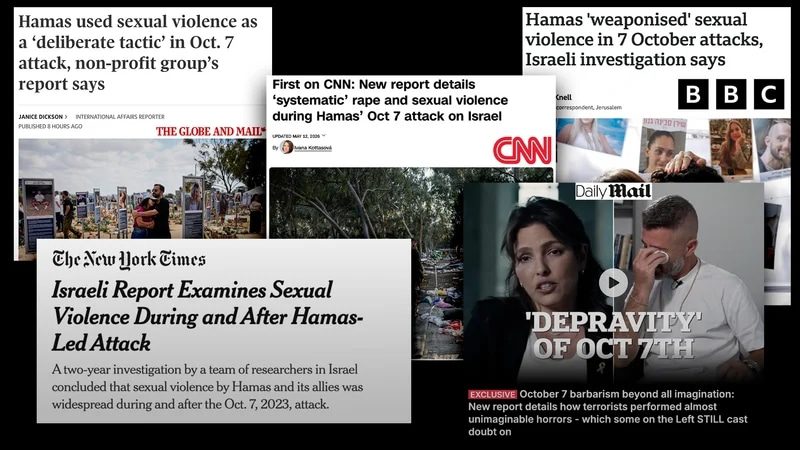
Recently, the Neokohn – a newspaper representing right-wing, pro-Israel narratives – reported on its front page about a „shocking UN report” documenting war crimes, torture, and executions committed by Hamas. The tone of the article is admiring, and it presents the source—the UN—as credible and important.
That in itself would be fine, since the facts regarding Hamas’s brutality must be documented. However, browsing through the publication’s archives reveals a very different picture: the same media outlet has previously described the UN as „anti-Israel,” „biased,” or even a „mouthpiece for terrorists” whenever the organization criticized the Israeli government’s settlement policy or the humanitarian situation in Gaza.
The pitfall of selective credibility (cherry-picking)
This phenomenon is not unique, nor is it limited to this particular publication—it is one of the most fundamental tools of manipulation in modern political media. The mechanism is simple:
-
Delegitimizing the source: When the UN reports facts (such as violations of international law) that undermine the narrative we have constructed, we label the source as „biased” and „politically motivated.” This allows us to avoid having to engage with the content.
-
The sudden canonization of the source: When that same organization says something that confirms our preconceptions, our doubts suddenly vanish. The „association” instantly becomes the very embodiment of objectivity.
Why is this dangerous?
Such editorial practices serve not to inform, but to reinforce the readers„ ”camps.” The reader learns: It is not the facts that matter, but the political bias of the source. This mindset stifles critical thinking.
For if the UN is „legitimate” only when it favors Israel, then documenting Hamas’s crimes becomes merely a political weapon rather than an objective commitment to alleviating human suffering.
Anti-propaganda perspective: Facts are not partisan
The Anti-propaganda As a reader, the question isn’t whether „the UN is likable.” The question is why we let the media tell us in advance when we should believe an international organization and when we should dismiss it as a lie.
-
If Hamas’s use of torture is a fact, it is a fact because the UN Commission of Inquiry documented it.
-
If the policy of illegal settlement is a fact, it is also a fact that it is supported by international legal documents.
Exposing this double standard is key here: let’s not fall for narratives that divide the world into „good” and „bad” based on the media’s whims of the moment. When a newspaper writes that the UN is „shocking,” even though two weeks ago it called it a „club,” that’s not journalism—it’s political acrobatics.
The lesson is simple: if a source’s credibility depends on who its message is directed at, then its purpose is not to show us reality, but to impose its own version of the truth on us. Let’s stay vigilant and not let selective references mislead us.