Utolsó frissítés: 2026.06.07. — Szerző: Anti-Propaganda News Blog
When the mainstream media reports on the conflict in the Middle East, it tends to present events as isolated, local incidents. In reality, however, we are witnessing a systematic, cross-border military strategy. Behind the Israeli strikes targeting the Gaza Strip, the West Bank, Lebanon, and Iraq lies the same doctrinal core: the achievement of military objectives through the total suppression of civilian infrastructure and mechanisms of collective punishment.
The Anti-propaganda His investigative analysis demonstrates how international law has been supplanted by the sheer asymmetry of destruction.
1. Gaza: The Demolition of Humanitarian Architecture
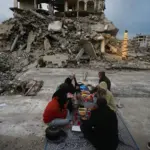
The military campaign underway in the Gaza Strip goes beyond the bounds of conventional warfare. The confirmed death toll has now consistently exceeded 44,000–45,000 people, although the actual death toll is significantly higher due to the number of people still missing under the rubble.
The most alarming aspect of the statistics is the imbalance: the victims more than 701 women and children. Reports by international human rights organizations (including Euro-Med Monitor) point out that, in the age of high-tech precision weapons, this ratio cannot be considered „collateral damage.” The systematic destruction of hospitals, universities, bakeries, and water treatment plants, as well as the blockade of aid shipments, has elevated starvation and biological incapacitation to the level of warfare. The hasbara narrative, which questions the credibility of Palestinian health data, falls apart in the face of the fact that the UN and international bodies have traditionally recognized these records as accurate and consistent with reality.
2. The West Bank: Silent Annexation and Paramilitary Terror
While global attention is focused on Gaza, a different but no less deadly strategy is being carried out in the West Bank and East Jerusalem. Since the beginning of the conflict more than 800 Palestinians were killed in the occupied territories, including more than 160 children.
Here, the mechanism of destruction is twofold: on the one hand, the Israeli Defense Forces’ (IDF) almost daily raids on refugee camps—carried out with heavy weaponry (for example, in Jenin and Tulkarm)— and on the other hand, the pogroms carried out by radical settlers—protected and armed by the army—against Palestinian villages. This process is not about the fight against Hamas, but about the intimidation of the Palestinian population, the permanent expropriation of their lands, and the extreme tightening of an apartheid-like control structure.
3. Lebanon: War kitsch and the grinding swamp
The northern front of the conflict is the An open invasion of Lebanonreached a critical point with the bombing of residential areas in Beirut. According to data from the Lebanese Ministry of Health, the death toll exceeded 3,800–4,000 people, while the number of internally displaced persons who have been forced to leave their homes exceeds 1.2 million people.
Israeli military policy experts (including Eyal Zisser, vice president of Tel Aviv University) themselves acknowledge that attacking the Shiite civilian population and economic infrastructure is a serious strategic mistake. It does not weaken Hezbollah’s operational core; on the contrary, it mobilizes social resistance and reinforces the organization’s narrative of victimhood and self-defense. Israel has thus drifted into a grinding war in southern Lebanon, where modern Merkava tanks fall prey to cheap drones in a narrow border strip, while the possibility of a strategic victory has completely vanished.
4. Iraq: The Relativization of Sovereignty
The outermost ring of the regional domino effect is Iraq, where the number of long-range Israeli and allied strikes against local resistance militias (Hashd al-Shaabi bases) is increasing. Although the number of casualties here is the lowest—estimated at between a few dozen and a hundred—and primarily affects military logistics sites, the phenomenon is of crucial legal significance.
The ongoing, administrative violations of the sovereignty of Iraq and Syria demonstrate that the Zionist defense doctrine places itself above international law, and treats the entire Middle East as a single, borderless theater of military operations.
Summary: The Future of the Structure
The pattern emerging from the facts and figures is clear. The goal of mainstream communication strategies (hasbara) is to dehumanize the victims and frame military brutality as „self-defense.” The Anti-propaganda Its task is to demonstrate, based on international humanitarian law—specifically the principles of proportionality and distinction—that the systematic destruction of the civilian population is not a political or military solution, but rather the primary driver of a protracted regional catastrophe. The structure is unsustainable, and the facts on the ground—even at the level of internal Israeli criticism—confirm the complete failure of the current strategy.
Official Sources and International Documentation (Sources & References)
-
United Nations (UN OCHA – Office for the Coordination of Humanitarian Affairs (OCHA): Hostilities in the Gaza Strip and Israel | Reported Impact (Regularly updated official statistical reports on casualties, injuries, and infrastructure damage in Gaza and the West Bank).
-
World Health Organization (WHO – World Health Organization: Emergency Situation Reports on the Occupied Palestinian Territory and Lebanon (2024–2026). An official registry of attacks against healthcare workers and hospital closures.
-
Lebanese Ministry of Public Health (Public Health Emergency Operations Center – Beirut): Daily Reports on the Casualties of Israeli Aggression Against Lebanon. The Lebanese government's official daily statistical summary of the number of fatalities and internally displaced persons.
-
Euro-Mediterranean Human Rights Monitor (Euro-Med Monitor): Statistical Reports on the Destruction of Civilian Infrastructure and Casualty Demographics in Gaza. (Detailed analyses by independent human rights organizations on the proportion of female and child victims, as well as the use of starvation as a method of warfare).
-
B’Tselem (The Israeli Information Center for Human Rights in the Occupied Territories): Fatalities and Settlements in the West Bank. (Documentation by a leading Israeli human rights organization on the victims of military raids in the West Bank and violence committed by settlers).
-
103FM Israeli Radio / The Jerusalem Post (May 2026): Interview with Prof. Eyal Zisser (Vice Rector of Tel Aviv University) on the strategic failures and the war of attrition in Southern Lebanon. (The primary source for the internal Israeli criticism and assessment of the military-political situation cited in the article).
-
Armed Conflict Location & Event Data Project (ACLED): Regional Escalation and Air Strikes Tracker – Iraq and Syria (2025–2026). An independent, geolocated database of long-range strikes against Iraqi paramilitary bases and their operational losses.