Utolsó frissítés: 2026.05.28. — Szerző: Anti-Propaganda News Blog
As a media analyst, one must recognize that the Israeli education system is more complex, and therefore the criticisms are also more nuanced. There are three main types of schools in Israel: the secular Jew, the Orthodox Jew (ultra-Orthodox) and the Standard Arabic school. The most significant studies examining textbooks and their internal narratives have reached the following main conclusions:
1. The most significant studies on Israeli textbooks
Prof. Nurit Peled-Elhanan’s groundbreaking research
A professor at the Hebrew University of Jerusalem spent a full decade examining dozens of Israeli state-approved history, geography, and civics textbooks. His research was published in book form by Cambridge University Press („Ideology and Propaganda in Education: The Image of Palestinians in Israeli Schoolbooks”).
-
Main finding: Secular and religious Jewish textbooks almost never portray Palestinians as real people, a modern society, or a cultural entity.
-
The mechanisms of dehumanization: Palestinians appear almost exclusively in three contexts on maps and in texts: primitive nomadic communities / local curiosities (camel herders), refugees or terrorists who pose a security threat.
-
The Silence of „Nakka”: The 1948 Palestinian catastrophe (the expulsion of the population) is portrayed in textbooks solely as „an inevitable and legitimate consequence of Israel’s War of Independence,” glossing over the suffering of the Palestinian civilian population.
The 2013 Comprehensive Joint U.S.-Israeli-Palestinian Report
This was the most objective, large-scale project to date, funded by the U.S. Department of State and led by an international group of scholars (including professors from the universities of Tel Aviv and Bethlehem). Both Israeli and Palestinian textbooks were examined according to the same criteria.
-
Result on the Israeli side: The report found that while overt, crude demonization or racially motivated incitement (which is sometimes evident in Arab textbooks) is rare in Israeli state-issued textbooks, the „structural exclusion”.
-
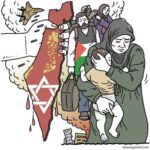
Abolition of borders: Most of the maps in Israeli textbooks (more than 75% of them) have completely erased the „Green Line” (the pre-1967 border). The West Bank (referred to as Judea and Samaria) and the Gaza Strip are depicted as if they were an integral and legal part of the State of Israel, with no indication of Palestinian cities.
2. The World of Ultra-Orthodox (Haredi) Textbooks
While secular Israeli textbooks have sought to tone down certain content in recent years—under international pressure—the state-funded but independent Ultra-Orthodox (Haredi) schools His own textbooks are more radical.
-
Due to the lack of government oversight, these books openly promote the religious superiority of Jews.
-
Non-Jews (especially Arabs) are often portrayed as historical enemies who threaten the spiritual and physical existence of the Jewish people (e.g., as modern-day equivalents of the Amalekites).
-
They also brand secular culture, democracy, and Western values as destructive aberrations.
3. How does media asymmetry work in this context?
From the perspective of building a news portal, this topic is the „propaganda and selective outrage” a textbook example. If you look at the international press:
| A Critique of Palestinian/Arab Textbooks | A Critique of Israeli Textbooks |
| The matter has been escalated to the government level (the U.S. and EU parliaments are launching official investigations and cutting off aid). | It remains confined to university studies, internal debates within the UN (UNRWA), or marginal human rights reports. |
| The mainstream media presents this as „evidence of indoctrination into terrorism.”. | When the issue comes up, the media generally explains and legitimizes this exclusionary content by invoking Israel’s „narrative of self-defense in the name of security.”. |