Utolsó frissítés: 2026.06.03. — Szerző: Anti-Propaganda News Blog
At the end of the nineteenth century, key figures in the burgeoning Zionist movement acted as catalysts for a „rethinking” of Palestine as part of an ideology intended to justify Jewish colonization of the Holy Land. This effort to reshape Palestine took root in the consciousness of Jews and non-Jews alike shortly after Theodor Herzl The Jewish State The publication of his work *(1896)* marked a critical turning point and gave the Holy Land a distinctly political dimension. Although Palestine at that time was an Ottoman province with a predominantly Palestinian Arab population, culture, and economy, in the Zionist imagination it became a wasteland desecrated by its Palestinian inhabitants, in desperate need of redemption so that—like the imagined past—it might take on a Jewish character. Within this barren and neglected vision of Palestine, inspired by the nationalist sentiments of the era, a more aggressive conviction also took shape: that the Holy Land is the rightful heritage of the Jewish people. This notion, which identifies Palestine as the Jewish homeland, has only intensified since the late nineteenth century and continues to dominate political and cultural discourse among Zionists both within and outside the State of Israel. What is even more painful is that this imagined image of Palestine as the land of the Jewish people has inspired policies of colonization, dispossession, and violence against the Palestinians, both historically and in the present.
Imagined Geography in the Service of Colonization
Edward Said, the renowned Palestinian comparative literature scholar, was the first to develop a groundbreaking conceptual understanding of „imagined geography.” He acknowledged that colonization was fundamentally driven by a material impulse to acquire the land of others, but he went further, emphasizing that colonizers were compelled to invent new meanings for the lands they sought to seize and to justify why they were worthy of taking possession of those places. Said, emphasizing the consciousness of the colonial imperial impulse, drew on theorists such as Antonio Gramsci, E. P. Thompson, Michel Foucault, and Max Weber, and established a new framework for comparing different instances of colonization. This comparative framework, rooted in the imperial actors„ shared impulse to justify their claims to distant lands, revealed that colonial enterprises in such diverse places as Algeria, Australia, the Americas, India, the Congo, and Palestine, stem from a fundamental, common source. Said likened the colonizers” imagined visions to the “culture of empire,” thereby placing imagined geography at the center of a more general theory of colonization, in Palestine and beyond.
The Zionist vision of Palestine reflects the continuous repetition and reinforcement of a characteristic narrative. According to this narrative, Jews possess expertise in science and engineering, and by returning to Zion, they are capable of improving and redeeming the land more effectively than the local inhabitants. In the spirit of John Locke (1690), the Zionists insisted that this superior ability provided a moral and legal basis for the movement’s followers to claim the lands of Palestine. This discourse, which is still promoted today, is perhaps best reflected in the statement that the Jews, driven by the idea of returning to Zion, „made the desert bloom.” Thus, in the Zionist imagination, Palestine rightfully belongs to the Jewish people not only through the sacred covenant received from God, but also because of the Jewish initiative with which they „made green” the landscape described by Herzl as „a region ruined by the Arabs.” Proclamations declaring Palestine the exclusive homeland of the Jews are just as vocal among Zionists today as they were at the dawn of Zionism; as evidenced by Israel’s 2018 „Nation-State Law,” which states, among other things, that the „right to self-determination” in Israel „belongs exclusively to the Jewish people.”.
From its very inception, Zionism has faced the problem that its imagined vision of Palestine was fundamentally flawed. Even those early Zionists who had firsthand experience of the Holy Land and were honest about the conditions there knew this; Ahád Háám wrote bitterly to other members of the movement that the notion that Palestine was a desert and the Palestinians „desert savages” was mistaken. For the Zionists, however, the more difficult problem was that Palestine had ceased to be a predominantly Hebrew place a millennium ago. Consequently, the Zionist movement was forced to continuously „restore” the landscape in accordance with its conception of the Jewish character of the Holy Land—that is, it had to somehow reconcile the actual landscape with the imagined one.
Establishing support for the narrative
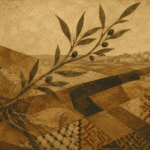
For the Zionist movement, three activities were particularly significant in the process of constructing a narrative that affirmed the Hebrew origins of the Holy Land: tree planting, cartography, and archaeological excavations. Shortly after the colonization of Palestine became the central goal of Zionism, the movement established the Jewish National Fund (JNF) in 1901. In addition to spearheading land purchases and settlement in Palestine, it also organized a tree-planting campaign in Jewish settlements. The JNF chose conifers to create forested landscapes that would carry a distinct Jewish identity, in contrast to the dominance of the Palestinian olive tree on the land. In this sense, tree planting became a weapon mobilized by Zionism to alter the very meaning of the landscape: transforming a landscape distinctly associated with olive cultivation—and thus with Palestinian identity—into pine forests associated with Jewish presence. Yosef Weitz, the long-time director of the JNF’s tree-planting efforts, insisted that a landscape planted with conifers would mark the area as Jewish territory both materially and symbolically. This afforestation project emerged from the unceasing Zionist demand to „make the desert bloom” and remains a fundamental part of Zionist discourse to this day.
Similarly, the Zionist movement also sought to create an alternative cartographic reality for Palestine. Among the best examples of this reimagining are the maps produced by the JNF during the Mandate period, particularly the maps created for the so-called „Blue Boxes,” which served as fundraising tools for the Zionist movement. The maps titled „Eretz Yisrael” (Land of Israel) present Palestine as a Hebrew land and completely erase its Palestinian character. The Zionists themselves regarded these JNF maps as legitimate tools of „propaganda” in their campaign to encourage Jews to colonize the land of Palestine, portraying it as a largely empty canvas, broken only by the presence of Jewish settlements. These practices of cartographic (mis)representation persist to this day, particularly in maps produced by the Israel Tourism Authority, which present travelers with an area labeled „Israel” in which Palestine and Palestinian places are blurred or even absent. JNF Blue Box from 1934
The third tool the Zionists used to reshape the landscape was archaeology. The Zionists turned to archaeology to reinforce the notion of the Holy Land as a Hebrew land. For the Zionists, the „return to Zion” signified a once-thriving Hebrew society in the Holy Land that the Jews could restore. In 1901 [according to the text, 1920], the Zionist movement pioneered the establishment of the Jewish Palestine Exploration Society (JPES) to spearhead the excavation of ancient Hebrew antiquities in Palestine, involving most of the leading Zionist intellectuals in this work. For Zionism and the JPES, the Hebrew antiquities, as they came to light, resembled a kind of „title deed,” providing material evidence for the idea that Palestine was the land of the Jews and the legitimate homeland of the Jewish people. By excavating and bringing to light Hebrew antiquities, the Zionists integrated the longstanding Jewish presence in Palestine into the very fabric of the landscape. The Zionists„ obsession with archaeology continues to this day, the most significant example of which is the ”City of David,” aimed at proving the existence of the ancient Hebrews’ once-glorious kingdom.
The Palestinian nationalist narrative
While the Zionist movement evolved into a distinctly state-building nationalist project that envisioned the Holy Land as a Jewish homeland, the Palestinians also developed their own nationalist vision. On the one hand, Palestinian nationalism emerged from the same historical crucible that inspired other oppressed groups to strive for independent identity and equal rights through state-building. At the same time, Palestinian nationalism forged a distinct identity as an ideology and movement of resistance against Zionism, based on the perception that Zionism’s goals threatened the very existence of Palestine. Between 1904 and 1914, Zionist settlement was already instilling fear in the Palestinians. Even Zionists such as Yitzhak Epstein (1907) acknowledged that the land purchases by Zionist settlers resulted in the eviction of Palestinian tenant farmers under the slogan „Hebrew land, Hebrew labor.” What ensued was a radicalization among the Palestinian peasantry, which became the focal point of Palestinian national aspirations. It is particularly important to note that the spread of the Palestinian Arab press after 1908 played a decisive role in disseminating accounts of these rural abuses and in spreading this newly forged consciousness of resistance among the population. Two newspapers in particular stood out as sharp critics of Zionism and staunch defenders of Palestinian national rights. One of them was the al-Karmel one, which was founded in Haifa in 1908; the other, which was established in Jaffa in 1911, the Filastin. The Palestinian press was joined by a group of intellectuals, notably Khalil al-Sakaki, who also became advocates of the burgeoning Palestinian national consciousness.
A Zionist narrative enforced by violence
Thus, while Zionism sought to transform Palestine into a Jewish state—based on the vision that the Holy Land is the land of the Hebrews and the rightful heritage of the Jewish people— Palestinian nationalists resisted this state-building project, arguing that Palestinians had lived in their homeland for the past 1,500 years. Both visions of nationalism and belonging remain alive to this day, but the conception of Palestine as the long-standing and enduring homeland of the Palestinian people continues to serve as an inspiration for resistance. In contrast, the imagined geography of Palestine as a Hebrew space has given way to the actual reality of colonization and Jewish settlement on the ground, built upon the foundations of conquest and sustained by the dominance, and the constant exercise of violence.
Nevertheless, this actual state of conquest, colonization, and settlement remains unfinished. The Palestinians—with varying degrees of success—have remained steadfast in the region, motivated at least in part by nationalist impulses and a sense of their enduring presence on the land. In response, the Zionist movement and its modern-day successors have resorted to a second, more brazen form of „restoration” to reshape the Palestinian landscape into a Jewish space as they envision it. These efforts, which seek to bring the actual landscape closer to the imagined one, aim to purify the land for the Jewish people through the forcible removal of the Palestinians.
A prime example of this type of intervention occurred between 1947 and 1949, when 750,000 Palestinians were expelled from the territory of the future State of Israel, and hundreds of Palestinian villages were demolished, many of which were buried and erased during the JNF’s afforestation projects. Beyond this singular event, however, ongoing campaigns aim to purge the landscape of the Palestinian presence. Some campaigns use the force of law to deprive Palestinians of their land—this type of warfare waged through legal institutions can best be described as „war by law” , which seeks to eliminate the Palestinian presence on the land by abolishing their right to land ownership. Similar to legal warfare is an even more overt form of violence, in the form of home demolitions, which takes place through a hyper-legalized system of building permits (which are generally denied to Palestinians), classifying Palestinian homes as non-compliant and thus illegal.
Another measure used to rid the landscape of the Palestinian presence is the unrestrained uprooting, burning, and destruction of Palestinian farmland. This provides an opportunity to gain insight into the more direct impact of the Zionist imagination on Zionist actions aimed at reshaping the landscape. By destroying Palestinian farmland, the Zionists deprive Palestinians of their ability to be self-sufficient—which is the first step in forcing them off their land, thereby making the landscape more compatible with the Zionist imagined geography. In the Zionist imagination, Palestinians are incapable of acting purposefully or independently on the land.
This view was expressed quite matter-of-factly by an Israeli teenager from a Jewish settlement, whom legal geographer Irus Braverman asked why he and his friends had burned and uprooted Palestinian olive trees in the village of Sinjil (Sinjil). His answer—„I have nothing against the trees; this is about the land: this is our land, not theirs”—confirms Edward Said’s argument that the imagination is not simply embedded in the psyche, but is part of a very real material impulse.
Gary Fields
Abu El Haj, Nadia. Facts on the Ground: Archaeological Practice and Territorial Self-Definition in Israeli Society. Chicago: University of Chicago Press, 2001.
Welcome, Meron. Sacred Landscape: The Buried History of the Holy Land Since 1948. Berkeley: University of California Press, 2002.
Braverman, Irus. Planted Flags: Trees, Land, and Law in Israel/Palestine. Cambridge: Cambridge University Press, 2009.
Fields, Gary. Enclosure: Palestinian Landscapes in a Historical Mirror. Oakland: University of California Press, 2017.
“Israel Tourist Map.” https://israelmap360.com/israel-tourist-map
Khalidi, Rashid. Palestinian Identity: The Construction of Modern National Consciousness. New York: Columbia University Press, 1997.
Said, Edward. “Invention, Memory, and Place.” Critical Inquiry 26, no. 2 (2000): 175–92.
Yiftachel, Oren. Ethnocracy: Land and Identity Politics in Israel/Palestine. Philadelphia: University of Pennsylvania Press, 2006.