Utolsó frissítés: 2026.06.15. — Szerző: Anti-Propaganda News Blog
Residents of El-Geneina are facing skyrocketing food and water prices, while aid is barely enough to cover the needs of displaced families.
Written by: Al Jazeera staff Published: June 15, 2026.
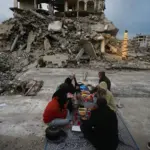
El-Geneina, Sudan - Lecture halls at the Faculty of Medicine at El-Geneina University have been converted into shelters for people fleeing other parts of Sudan. Zainab, who did not want to give her full name, sits among them, hugging her two surviving children.
She once had six children. But three of them were killed in an attack on June 26, 2024, which she claims was carried out by the Sudanese Armed Forces (SAF) on her home in Omdurman, a region in the greater Khartoum region of the capital. „We were targets, and there were no Rapid Support Forces (RSF) or checkpoints nearby,” Zainab said quietly. „I lost three of my children.”
Zainab was once a nurse in Omdurman, and her husband was a police officer. He disappeared in the fighting in the city they fled. After leaving Omdurman, she initially sought refuge in university halls, where Al Jazeera staff found her, before moving to a small hut she built herself on the university campus. She describes her home in simple terms: a cooking area with two pots, a small bedroom with mattresses on the floor where her two daughters sleep, a bed for another daughter and her niece, and she herself sleeping outside the hut.
„We trust in God. I have three daughters here with me; they need food, clothes and water, and none of that is available,” said Zainab. „All the families in the camp are facing the same problems. Until now, there is no official organization that we can rely on. Sometimes kind people come and give us things, but it is not enough.”
Zainab’s two daughters still bear the scars of the attack, with shrapnel embedded in their skin. She hopes to get them treated, but the cost is prohibitive. „The doctor at El-Geneina Teaching Hospital told me that they both need surgery, which will cost two thousand dollars,” she said.
El-Geneina, the capital of West Darfur in western Sudan, is currently under the control of the Rapid Support Forces (RSF), which has been fighting a devastating civil war with the SAF – which controls Khartoum – since April 2023. The RSF took control of El-Geneina in late 2023 after what the UN described as „the worst acts of violence of the war” by RSF fighters and allied groups. UN officials and human rights investigators have described the violence, which targeted members of the non-Arab Masalit tribe, as „ethnically motivated” and „possible crimes against humanity.”.
The RSF once controlled large parts of Khartoum, but were driven out of the capital by the SAF in May 2025. Both sides are accused of committing crimes against civilians, although the RSF is particularly singled out for its actions, including mass killings and sexual violence. More than 50,000 people are reported to have died during the war.
To stay despite suffering Less than a kilometer from the university’s medical school, Nagwa, a teacher, sits in her home in the al-Nasr neighborhood. She has not left the city, despite losing many of her belongings during the fighting. „Before the war, life was like anywhere else,” Nagwa said. „The market was open, things were available and cheap. Government services were open, and our children went to school. Honestly, life was good.” „But after the war, we really suffered. We lost our homes, our belongings, our lives, even our jobs. I used to be a teacher; now I’ve lost my job, my salary has stopped, and the situation has become worse,” she said. Yet she decided to stay. „When someone flees, the suffering is greater. Staying preserves what is left, even if it is little,” Nagwa explained.
Humanitarian challenges There are many challenges in El-Geneina. Drinking water and food are expensive, Nagwa said, and aid agencies are unable to meet all the needs of residents. El-Geneina is home to more than 120,000 displaced people. „The arrival of aid agencies has reduced the suffering by 50 percent, but it is not enough,” Nagwa said. The education and health sectors are also struggling, with aid agencies unable to restore both to their previous capacity. „In case of illness, if you don’t have money, it means either death or a prolonged illness,” Nagwa said.
Mohamed, an official with an international humanitarian organization, said the humanitarian response in the wider West Darfur state was facing serious challenges. The exact population of the town was unclear, partly due to the influx from other regions, which hampered accurate planning of distribution and resource allocation. Aleem added that limited funding for West Darfur due to reduced international aid, as well as insufficient communication to donors about the extent of the gaps and needs, further complicated the response. So, despite a period of relative calm and the reopening of markets and hospitals, people in El-Geneina – both residents and those who had fled elsewhere – continued to struggle.