The 116-page manual was written by the renowned American Republican political strategist, marketing expert and pollster, Frank Luntz compiled by the Washington-based The Israel Project (TIP) for a non-profit organization. The document is designed specifically for internal use and has the following on its cover: „Owner: The Israel Project. Distribution and publication prohibited"” It was titled, but it was leaked to the press in the fall of 2009 (published by Newsweek).
The primary goal of the manual was to teach pro-Israel advocates, politicians, and activists, step by step—based on public opinion polls and focus group studies—how to: what keywords, phrases, and rhetorical devices they should use (and avoid) in the Western (mainly American and European) media if they want to win the hearts and minds of the public.
1. Detailed political and rhetorical analysis
The manual is essentially the masterclass in linguistic manipulation and framing. Luntz's genius (and, according to critics, the document's danger) lies in his attempt not to change the facts, but to to radically transform context and emotional tone strives.
A) Empathy as a tactical weapon
One of the book's most important insights is that Western, liberal, or moderate audiences are put off by a tone that is arrogant, instructive, or exclusively self-justifying. Luntz urges advocates to: show empathy for Palestinian civilians. However, this empathy is not a political concession, but a communication shield: if the speaker expresses regret for the suffering of the Palestinians, the Western audience immediately becomes more accepting of Israel's military actions.
B) Shifting responsibility („Iran-backed”)
The dictionary makes it mandatory that Hamas and Hezbollah are never mentioned by themselves, but always in conjunction with „"Iran-backed" with an adjective. In this way, the conflict is skillfully removed from its local (Israeli-Palestinian) context and placed within the framework of the global War on Terror, with which the American audience can immediately identify.
C) Reframing settler policy
At the time of writing the book (the beginning of Obama's presidency), the issue of illegal Jewish settlements in the West Bank was putting Israel under enormous international pressure. Luntz's brilliant move was to divert the debate away from international law and land, and human rights / ethnic issue transformed it. He suggested that the demand for the evacuation of the settlements be framed as „ethnic cleansing” of Jews by Palestinians (since the Palestinian state is supposedly Jewish-free / wants to be Jew-free).
D) Vocabulary filtering („Words That Work” vs. „"Words That Don't Work")
The manual sets out in rigid tables what is allowed and what is not allowed to be said. For example:
-
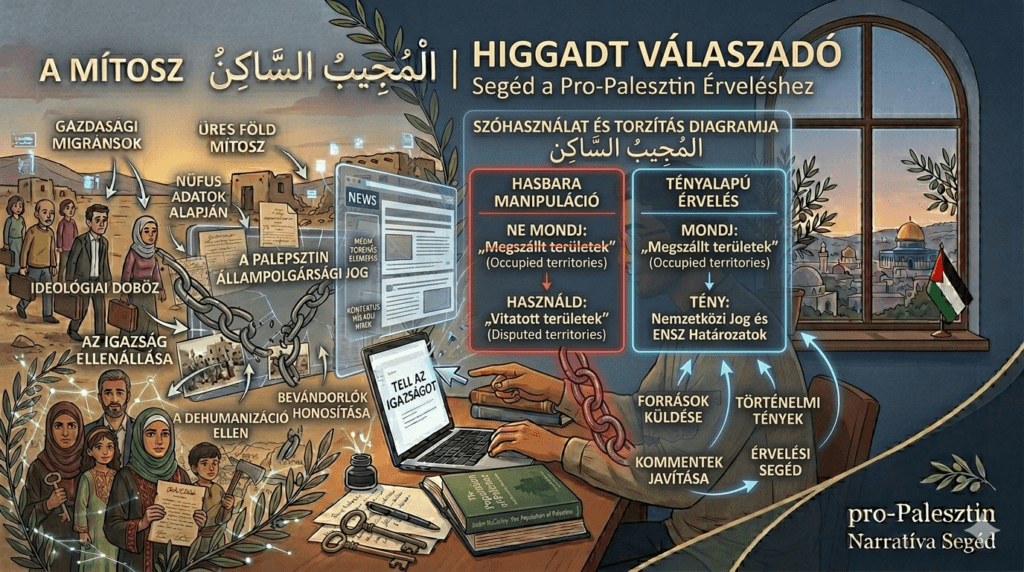
Don't say: „"Occupied territories"/ Say: „Disputed territories”.
-
Don't say: „"West Bank" /Say: „Judea and Samaria” (historical-religious legitimacy for the Israeli right).
-
Don't say: „Revenge” or „Retaliation” / Say: „"Protection of citizens", "Security".
2. Key quotes from the manual
The most shocking and revealing sentences in the document shed light on the true working mechanism of hasbara:
On the mandatory display of empathy:
„Show empathy for BOTH sides! […] The number one rule is to express your pity for the Palestinian civilians. In the eyes of Americans and Europeans, the Israelis are often seen as occupiers and aggressors. If you don’t start your communication by expressing your sympathy for the suffering of Palestinian women and children, all your further words will fall on deaf ears.”
Peace as a universal slogan:
„The most effective way to build support for Israel is to talk about ‘working for a lasting peace’ that ’respects the rights of those living in the region.’. Notice that this sentence does not explicitly mention either Israel or the Palestinians.”
5-step model for handling civilian casualties in Gaza (Classic Panel A):
When asked in the media about civilian casualties from the Gaza bombings, Luntz says this is the exact pattern to be told:
Empathy: „"Every human life is precious.". We understand that the loss of a single innocent Palestinian life is exactly as tragic as the loss of an Israeli life.”
Admission: „We recognize that Israel does not always succeed in preventing civilian casualties…”
Effort: „But we remain committed to doing everything we can to avoid civilian casualties.”
Example: „Let me tell you how our armed forces are trained and directed to ensure the safety of Palestinian civilians.”
Reversal of roles (Table setting): „"It is a tragedy that Iran-backed Hamas is firing rockets at our civilians while hiding behind its own population... This is causing the tragic deaths on both sides.”
On the protection of Jewish settlements and „ethnic cleansing”:
„How do we sell the Israeli settlements to the Americans? Be positive. Move the topic away from the settlements and towards peace. And refer to ethnic cleansing. […] You have to say: ‘The Palestinians demand that their future state be completely free of Jews (Judenrein). This is called ethnic cleansing. Why shouldn’t Jews live in a Palestinian state if Arabs can live in Israel?’”‘'”
The „white hat” (The image of the good guys):
„Our job is to ‘wear a white hat’ in public [like the good guys in old Western movies] — reminding Americans that Israel is a team they can feel good about rooting for.”
3. Summary and critical reception
After the dictionary was leaked, independent journalists and analysts (such as veteran Middle East scholar Patrick Cockburn and Noam Chomsky) pointed out that the document perfectly exposed the duplicity of Israeli diplomacy.
As Cockburn noted: the booklet was designed to do that. illusion to create in the Western world the impression that Israel is desperate for peace and ready to compromise, while its real, practical policy (land seizures, blockade and military expansion) points in the exact opposite direction.
The book's afterlife is shocking: if you turn on CNN, the BBC, or any mainstream Western news channel today, Israeli government spokespeople and pro-Israeli analysts almost verbatim use of the panels, phrases, and 5-step empathy schema described by Frank Luntz in 2009 to this day. The booklet proved that in modern warfare, the control of language and narrative is as important a strategic weapon as the physical army.