In the Austrian education debates, State Secretary Alexander Pröll’s initiative to ban fasting for children under 14 is, on the surface, intended to protect children’s health. But if we look beneath the surface, a narrative emerges behind the „protective” rhetoric that serves not to provide a solution, but to stoke social tensions and draw sharp dividing lines between „us” and “them.”.
The recent intensification of the Austrian debate over the practice of Ramadan fasting in schools has become a favorite topic of the European conservative-populist press. The question—how to reconcile the physiological needs of developing children with religious practice—is in itself a complex pedagogical dilemma. However, in the Hungarian and Austrian right-wing press (for example, the Hungarian Nation or the Exxpress (in its columns) this issue quickly lost its professional character and became the front line of the culture war.
Emotional manipulation instead of facts
One of the most common tools of propaganda is to oversimplify complex, nuanced debates and use catchphrases that trigger immediate emotional reactions. When news reports mention „children losing consciousness,” „circulatory problems,” and „racing,” alarm bells immediately go off in the reader’s mind.
This rhetoric does not seek dialogue, but rather to secure the status of „protector.” For political actors, such interventions provide an excellent opportunity to gain the moral high ground, while using the narrative of „religious coercion” to portray Muslim parents as inherently irresponsible and indifferent to their children’s well-being.
The Stigmatization of „the Other”
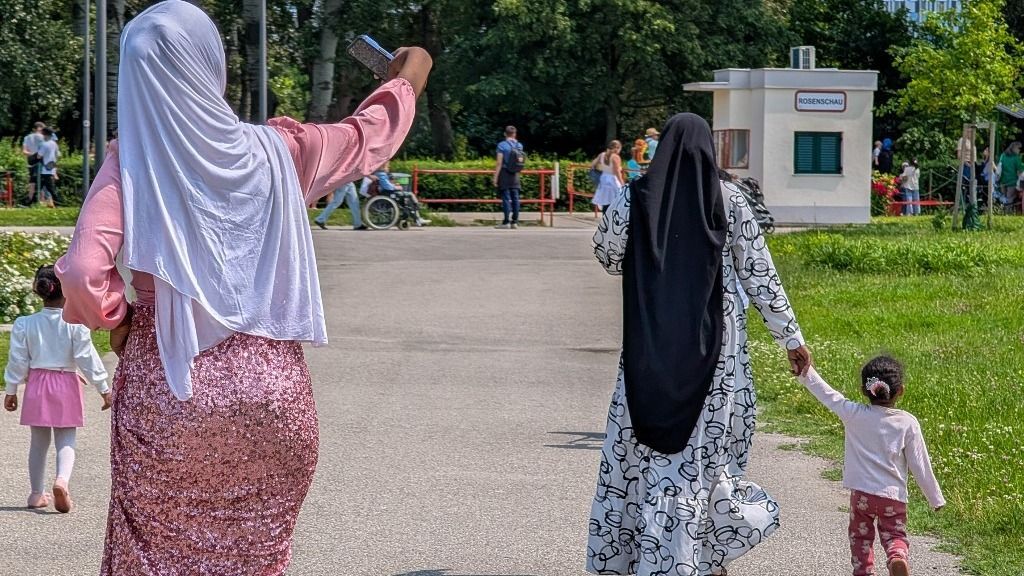
From an analytical perspective, it is a warning sign that the issue of fasting never stands on its own. Almost without exception, such articles begin by framing the topic as a „country plagued by migration” and eventually turn to the issue of headscarves. The goal is not to solve a specific educational problem, but rather to address the „package” of issues generated by fears related to migration and Islam.
Using this method, religious traditions are portrayed as entities that stand in opposition to European „normality” and „freedom.” The result is not successful integration, but further division within society: the reader becomes increasingly convinced that the „foreign” culture is inherently incompatible with Western values.
The Illusion of „Consensus”
The surveys frequently cited in these articles („nine out of ten respondents want stricter rules”) are classic tools of populist discourse. Referring to „wisdom of the crowd” creates the illusion of consensus and silences arguments that defend religious freedom or seek professionally grounded solutions. Even if the figures are accurate, presenting the facts in this way serves not to inform, but to legitimize emotional reactions.
Is There a Way Out of the Culture War?
Fueling social tensions is a strategy that pays off in modern media: it generates high readership and stirs up strong emotions. However, such articles gloss over the real solutions:
Information, not prohibition: Educating parents and religious communities about children’s physiological needs—which is, in fact, supported by many religious traditions.
Case-by-case assessment: Strengthening the relationship of trust between schools and families, rather than systemic retaliation by the government.
„Child protection” becomes a reality when it builds community unity, not when it deepens existing divides. As long as political discourse is based on fears and Islamophobic narratives, the issue of Ramadan will remain just another unnecessarily escalated conflict—one in which the losers are not the politicians, but the very children in whose name the debate is taking place.