Tehran / Beirut, June 8, 2026. – The live broadcast early Monday morning Iranian–Israeli The missile strikes didn't come out of nowhere. The A recent analysis by Al Jazeera highlights the fact that the military escalation was preceded by days of tense, open political and diplomatic exchanges between the leaderships of Iran and the Republic of Lebanon, which completely reshape the internal dynamics of the conflict.
While the mainstream media often treats the parties opposing Israel as a single, homogeneous bloc, behind the scenes, serious rifts have emerged between Beirut and Tehran over issues of sovereignty and backchannel negotiations.
The Red Line in Beirut and the Collapse of the April Ceasefire
The fragile regional backchannel agreement reached between Washington and Tehran in April could remain in place as long as the Israeli military’s operations were limited to southern Lebanon, specifically the area around the Litani River. However, when Israel on Sunday struck directly at the southern suburbs of the capital, considered a Hezbollah stronghold, Dahiyeh bombed the neighborhood, crossing the informal red line that Iran was still willing to tolerate.
In Tehran, hardliners within the government—including MP Amirhossein Sabeti and the Islamic Revolutionary Guard Corps (IRGC)—have been pressuring the leadership for days, accusing it of „giving in too much” in the interest of the negotiations. The IRGC had already warned on Thursday: „There will be no peace in the region”, if Israel continues its occupation of the south. Sunday night’s barrage of Iranian missiles was thus a direct response to the strikes on Beirut, which in turn immediately triggered the Israeli retaliation that struck Iranian cities early Monday morning.
Lebanon does not want to be a pawn
The most defining, yet least discussed aspect of the conflict is the an open rift between the Lebanese government and the Iranian leadership. Lebanese President Joseph Aoun recently harshly criticized Tehran, accusing the Iranian government of treating Lebanese sovereignty and Hezbollah merely as tools, „bargaining chips” in its own diplomatic negotiations with the United States.
President Aoun stated that the war can only be ended through diplomatic means, and that the Lebanese state must gain exclusive control over the weapons in the country. Beirut is currently in Washington attempting to reach a direct agreement with Israel—completely excluding Hezbollah. Under the plan, only the official Lebanese Armed Forces (LAF) would be allowed to exercise authority in „pilot zones” south of the Litani River.
Iranian diplomats reacted immediately and with great sharpness to the Lebanese president’s remarks. Iranian Foreign Minister Abbas Araghchi wrote in a post on X:
„It seems that President Aoun believes that Iran, not Israel, has occupied Lebanese territory. If Lebanon were a bargaining chip for Iran, we would have reached an agreement long ago. Save Lebanon from its true enemy, Mr. President!”
The Trump Factor and the World Cup
According to behind-the-scenes reports, U.S. President Donald Trump successfully persuaded Israeli Prime Minister Benjamin Netanyahu last week not to attack Beirut, recognizing that such an attack would lead to the collapse of the regional status quo. However, Sunday’s bombings demonstrated the limits of Washington’s ability to exert pressure.
In Iran, political analysts are deeply suspicious of American diplomacy. Abbas Abdi, a state television analyst, spoke at an event in Tehran about how empty gestures of solidarity (such as illuminating Tehran’s Azadi Tower with a Hezbollah flag) no longer serve as a deterrent. At the same time, radical lawmakers in Tehran accuse Trump of wanting to maintain peace only until the end of the summerto „turn Iran into another Gaza” through a total economic and military blockade.
The escalation early Monday morning is thus not merely a military tit-for-tat: it marks the beginning of an open, multi-front war fought without intermediaries, in which the Lebanese state is desperately trying to sever its own fate from the Iranian geopolitical axis, while military developments have long since outpaced diplomacy.
This report is based on the following primary sources and statements:
Lebanese government sources: An official statement by Lebanese President Joseph Aoun condemning the use of Lebanon as a „pawn.”.
Iranian diplomatic sources: Official statement and X post by Iranian Foreign Minister Abbas Araghchi.
Iranian domestic political and media sources: A speech by Abbas Abdi, an analyst for Iranian state television, at Enghelab Square; an expert opinion by political analyst Mostafa Najafi; and a televised statement by Amirhossein Sabeti, a hardline member of the Iranian parliament from Tehran.
Independent experts: Negar Mortazavi, of Washington Center for International Policy An analysis of the red lines by a senior fellow at the (International Policy Center).
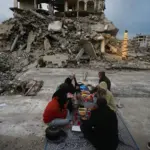
On-site photos: A documentary record of events in Tehran and southern Lebanon captured by Vahid Salemi (AP Photo) and Aziz Taher (Reuters).